
Surviving and Avoiding Immigration Scams In Canada
Moving to a new country is one of the most courageous decisions a person can make. As immigrants, we leave behind our homes, our extended families, and our comfort zones to build a stronger, more secure future in Canada. We save for years, make countless sacrifices, and pour our hearts into the dream of permanent residency and financial stability.
Moving to a new country is one of the most courageous decisions a person can make. As immigrants, we leave behind our homes, our extended families, and our comfort zones to build a stronger, more secure future in Canada. We save for years, make countless sacrifices, and pour our hearts into the dream of permanent residency and financial stability.
Unfortunately, where there is hope and desperation, there are also predators. The immigration system is complex, and the stakes are incredibly high. Scammers and fraudsters know this. They prey on the vulnerability, language barriers, and lack of local knowledge that many newcomers face. Losing thousands of dollars to an immigration scam is not just a financial devastating blow; it can result in deportations, denied applications, and a complete shattering of your Canadian dream.
At Thrive Nation Finance, our mission is to close the information gap and protect our community from costly mistakes. We believe that financial literacy and immigration success go hand-in-hand. You cannot build wealth if you are losing your hard-earned savings to fraudsters. In this comprehensive guide, we are taking a deep dive into the dark world of immigration fraud. We will expose the most common scam schemes targeting immigrants today, teach you how to spot the red flags, show you how to report and recover lost money, and empower you with the safest strategies to navigate your Canadian immigration journey.
Why Do Smart People Fall for Immigration Scams?
Before we look at the specific scams, we need to address a common myth: that only "gullible" people get scammed. This is entirely false. Scammers are professional manipulators. They do not target your intelligence; they target your emotions. When you are navigating the Canadian immigration system, you are dealing with strict deadlines, confusing legal jargon, and the anxiety of potential rejection. When someone comes along offering a "guaranteed" shortcut, a secret loophole, or a promised job that will solve all your problems, it is human nature to want to believe them. Scammers exploit this hope. They also exploit authority, knowing that immigrants are deeply respectful of government officials and police. By understanding the psychology behind these attacks, you take the first step toward defending yourself.
Exposing the Most Common Immigration Scams
Fraudsters use a variety of sophisticated schemes to separate you from your money. Here are the most prevalent scams targeting newcomers and prospective immigrants to Canada today.
1. The "Ghost Consultant" Scam
In Canada, anyone who provides immigration advice for a fee must be authorized by the government. This means they must be a licensed lawyer in good standing or a Regulated Canadian Immigration Consultant (RCIC) registered with the College of Immigration and Citizenship Consultants (CICC).
A "ghost consultant" is an unlicensed, unregulated fraudster who claims to be an immigration expert. They often operate through social media, WhatsApp groups, or word-of-mouth. They charge exorbitant fees to "help" you with your application, but because they are unlicensed, they refuse to put their name or registration number on your official paperwork. They will fill out your application, take your money, and then tell you to submit the application as if you did it yourself. If the application is rejected, or if they disappear with your money, you have zero legal recourse. Even worse, ghost consultants frequently forge documents or lie on applications to make your profile look better. If Immigration, Refugees and Citizenship Canada (IRCC) discovers this, you are the one held responsible for misrepresentation, which can lead to a five-year ban from entering Canada.
2. Fake Job Offers and the LMIA Trap
For many prospective immigrants, the Express Entry system is highly competitive. Getting a valid job offer backed by a Labour Market Impact Assessment (LMIA) can add crucial points to your profile. Scammers know how desperate people are for these points. Fraudsters, sometimes working with corrupt business owners, will "sell" you a job offer and an LMIA for anywhere from $10,000 to $50,000. They will tell you this is a normal part of the Canadian immigration process.
This is a critical fact: In Canada, it is completely illegal to charge a job seeker for a job offer or an LMIA. The employer is legally required to cover all costs associated with hiring a foreign worker. If someone asks you to pay for a job, it is a scam. Victims of this scam often arrive in Canada only to find that the company doesn't exist, the job was a lie, or they are forced to work in abusive, underpaid conditions to "pay off" their illegal debt to the employer.
3. Government Imposters and Extortion
Imagine receiving an aggressive phone call from someone claiming to be an officer with IRCC, the Canada Border Services Agency (CBSA), or the Canada Revenue Agency (CRA). The caller knows your name and tells you that there is a severe problem with your immigration file, or that you owe back taxes. They threaten that if you do not pay a massive fine immediately, police will arrive at your door to arrest and deport you.
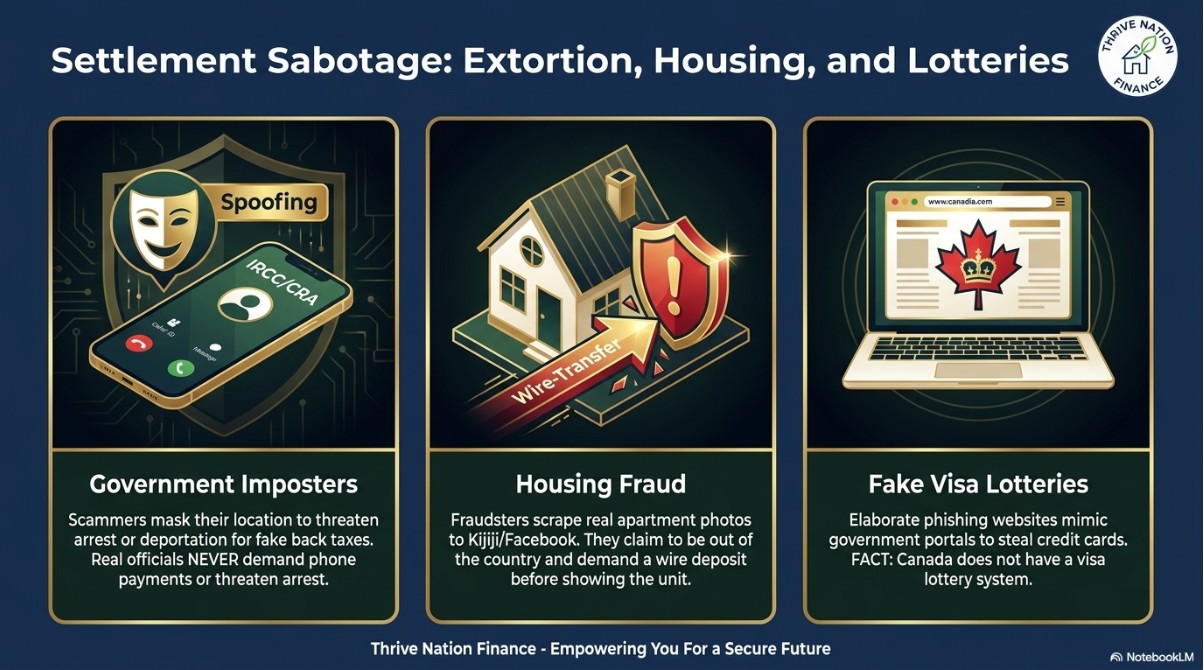
This terrifying scenario is one of the most common extortion scams in Canada. The scammers use software to "spoof" caller ID, making it look like the call is genuinely coming from a government office. They rely on the sheer panic and fear of deportation to force you into making a hasty decision. Real Canadian government officials will never call you to threaten arrest, nor will they ever demand payment over the phone.
4. Housing and Rental Fraud
Scammers don't just target your visas; they target your settlement. In today's tight housing market, finding a place to rent is incredibly stressful. Fraudsters will scrape photos of real apartments from legitimate real estate websites and post them on sites like Kijiji, Craigslist, or Facebook Marketplace at surprisingly affordable prices. When you contact them, they will claim they are currently out of the country or unavailable to show you the property. They will demand that you wire them a security deposit or first month's rent to "secure" the apartment, promising to mail you the keys. Once you send the money, they disappear. Many newcomers arrive in Canada with their suitcases, only to find that the apartment is occupied by the real owner who has no idea who they are.
5. Fake Visa Lotteries and Phishing Websites
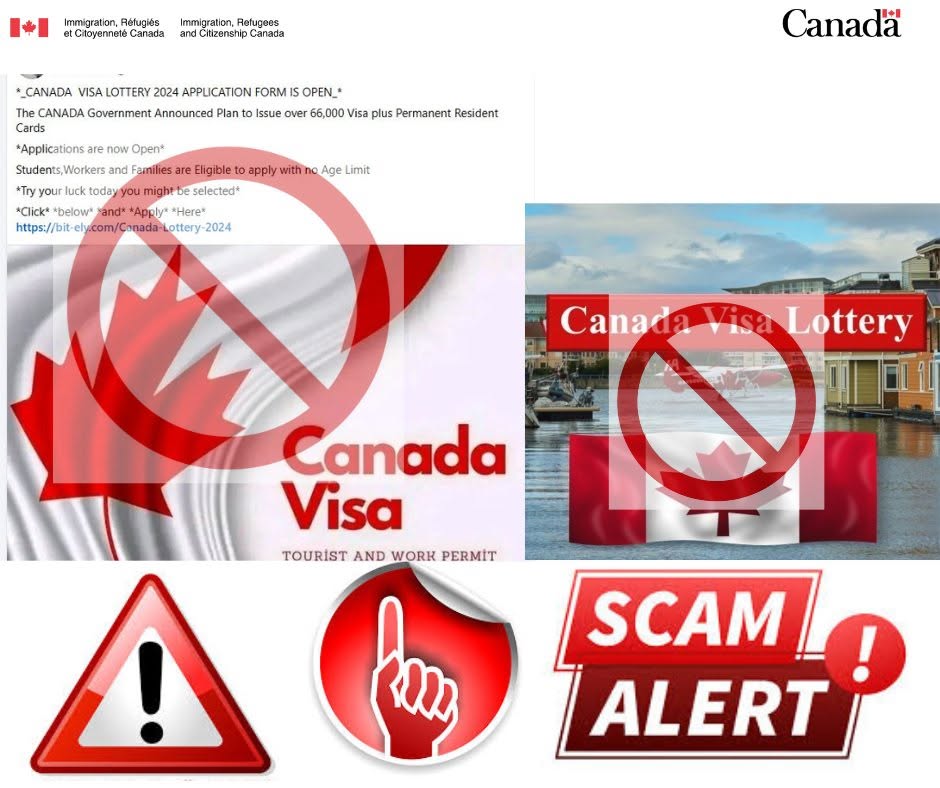
Some scammers build elaborate websites that perfectly mimic official Canadian government portals. They send out mass emails claiming you have been randomly selected in a "Canadian Visa Lottery" and simply need to pay a processing fee to claim your permanent residency. First, Canada does not have a visa lottery system. Second, these fake websites are designed to steal your credit card information and your identity.
The Golden Rule: Official Fees vs. Free Services
To protect yourself, you need to understand exactly how the Canadian government handles money. There is a lot of confusion about what is free and what costs money in the Canadian immigration system. The truth is: Official applications are not free, but settlement help is.
The Government of Canada has strict, published processing fees for almost all immigration applications, including study permits, work permits, and permanent residency. You must pay these fees for your application to be processed. However, you must only ever pay these fees directly through the official government web portal, which always ends in .gc.ca or .canada.ca. Conversely, the Canadian government funds hundreds of settlement organizations across the country. These organizations provide free services to eligible newcomers, including language assessments, resume building, job search assistance, and community integration. If anyone ever tells you that you need to pay a fee to access basic newcomer settlement services, or if someone tells you to pay your official government visa fee by wiring money to a personal account, you are being scammed. Furthermore, no real government official will ever ask you to pay fines, taxes, or fees using gift cards (like Apple or Google Play cards), cryptocurrency (like Bitcoin), or wire transfers like Western Union.
The Safest Approach: Do-It-Yourself and Trusted Referrals
One of the biggest misconceptions among newcomers is the belief that you must hire a lawyer or a consultant to succeed. Fraudsters actively promote this myth to make you feel dependent on them.
The Do-It-Yourself (DIY) Advantage
The safest way to avoid an immigration scam is to handle the application yourself. The Government of Canada treats all applications exactly the same, whether they are submitted by a high-priced lawyer or by you sitting at your kitchen table.
All official application forms, document checklists, step-by-step instruction guides, and policy manuals are available for free on the official IRCC website. By taking the time to read the instructions carefully, gathering your own documents, and submitting your application directly through the government portal, you completely eliminate the risk of ghost consultants. You also save thousands of dollars that can be better used to build your financial foundation in Canada.
Rely on Authorized Referrals
We understand that not every case is simple. If you have a complex medical history, a previous visa refusal, or a complicated legal background, you may legitimately need professional representation. If you decide to hire help, never choose someone based on a random social media advertisement, a YouTube comment, or an unsolicited message in a WhatsApp group. Scammers thrive in these unverified, anonymous spaces. Instead, use trusted, authorized referrals. At Thrive Nation Finance, we do more than just teach financial literacy. We are your partners in building a strong life in Canada. If you need professional immigration assistance, Thrive Nation Finance helps prospective immigrants with credible information and authorized referrals to fully licensed, vetted professionals. We ensure that you are connected with legitimate experts, keeping your money and your future safe.
Spotting the Red Flags Before It’s Too Late
Education is your best armor. Before you sign a contract or transfer a single dollar, look out for these massive red flags:
The 100% Guarantee: If anyone guarantees that your visa will be approved, run away. No consultant or lawyer can guarantee an outcome. The final decision is made exclusively by an IRCC officer.
The Unwillingness to Provide Credentials: Legitimate consultants will proudly display their CICC R-Number. Legitimate lawyers will share their provincial bar association details. If they refuse to give you their license number, they are a ghost consultant.
Refusal to Sign a Retainer Agreement: Authorized professionals are legally required to provide you with a written contract (a retainer agreement) outlining exactly what services they will provide and what it will cost.
"Secret" Connections: If a consultant claims they have "friends on the inside" at IRCC who will fast-track your file for an extra fee, they are lying. The system does not work this way.
Paying for a Job: We will repeat this because it is so important: if an employer or recruiter asks you to pay a fee to secure a Canadian job offer or LMIA, it is an illegal scam.
Refusal to Show Housing: If a landlord refuses to show you an apartment in person, or via a live video call, and demands a deposit first, it is a rental scam.
How to Report Immigration Fraud
If you spot a scammer, or if you have unfortunately fallen victim to one, it is vital to report it. Many immigrants are terrified to report fraud because they fear it will negatively impact their own immigration status. Please know that reporting a scam to the authorities is the right thing to do and helps protect the broader immigrant community. Here is exactly who to contact based on the situation:
Suspected Immigration Fraud or Ghost Consultants: Contact the Canada Border Services Agency (CBSA). You can call their Border Watch Line toll-free at 1-888-502-9060. They also offer a secure online web form. You can report these crimes anonymously.
Fraud Tied to Your Specific Application: If a scammer has messed up your ongoing application, you must inform IRCC immediately. Use the IRCC web form or call the IRCC Client Support Centre at 1-888-242-2100 from within Canada.
Financial Loss and Cyber Crime: If you have lost money, had your identity stolen, or encountered a fake website, report it to the Canadian Anti-Fraud Centre (CAFC). They track fraud trends nationwide and work with police.
Fake Job Offers and LMIA Abuse: If you paid for a job, or an employer is abusing the LMIA system, report it to the Service Canada National Investigative Services at 1-866-602-9448.
Licensed Consultant Misconduct: If your consultant is licensed but committed fraud or acted unethically, file a formal disciplinary complaint directly with the College of Immigration and Citizenship Consultants (CICC).
Damage Control: Can You Recover Lost Money? Recovering money sent to a scammer is incredibly difficult, but it is not always impossible if you act with extreme speed. Your options depend entirely on how you paid.
Credit Card Payments
If you paid a scammer using a major credit card (Visa, Mastercard, American Express), you have the highest chance of getting your money back. Consumer protection laws allow you to initiate a "chargeback" for fraud or services not rendered. You generally have a 120-day window from the transaction date to do this. Call the fraud number on the back of your credit card immediately, explain that you were defrauded by a fake consultant or merchant, and provide them with all your emails and receipts as evidence.
Interac e-Transfers and Bank Wires
E-transfers and wire transfers are treated like cash. Once the scammer deposits the funds, they are almost impossible to reverse. If you realize you have been scammed, you must call your bank's fraud department within hours. If the money has not yet been deposited by the scammer, the bank might be able to cancel it. If it has been deposited, ask your bank to contact the receiving bank to freeze the fraudster's account. While full recovery is rare, immediate action is your only hope.
Money Service Businesses (Western Union / MoneyGram)
Scammers love these platforms because they can pick up cash anonymously anywhere in the world. If you sent money this way, call the company's emergency fraud hotline immediately. If the scammer has not yet picked up the physical cash, the transaction can be halted and refunded. Once it is picked up, the money is gone.
The CICC Compensation Fund
If you were defrauded by a licensed immigration consultant (an RCIC), there is good news. In July 2026, the CICC is launching a Compensation Fund. If a licensed consultant stole your money or misappropriated your funds, and the CICC disciplinary committee finds them guilty, you can apply to this fund to recover your losses. This is exactly why you must only use licensed professionals—you have a financial safety net that simply does not exist if you use an unlicensed ghost consultant.
Beware of Secondary Scams: If you have lost money to a scammer, your contact information will likely be sold to other criminals on a "sucker list." You may receive emails or calls from people claiming to be hackers, private investigators, or law enforcement offering to recover your lost money for an upfront fee. Do not believe them. This is a secondary scam. Legitimate authorities and banks will never ask you to pay a fee to investigate fraud or recover stolen money.
Conclusion: Empowering Your Journey
Your journey to Canada is an investment in your family’s generational wealth and future. At Thrive Nation Finance, we want to see you succeed, settle smoothly, and thrive financially. Protecting your hard-earned money from scammers is the first step in your Canadian financial education. By knowing the red flags, understanding that government processing fees are separate from free settlement help, having the confidence to complete applications yourself, and relying only on authorized referrals from trusted partners like us, you are taking control of your destiny. Do not let fear dictate your immigration journey. Arm yourself with knowledge, share this information with your community, and if you ever feel unsure about an immigration offer or a financial decision, reach out. Thrive Nation Finance is here to provide the mentorship, education, and trusted network you need to shorten your learning curve and avoid costly mistakes.
Want to learn more about building a strong financial foundation in Canada? Explore our free guides, join our upcoming webinars, or book a one-on-one session today. Let's thrive together.