
America’s Power Crisis: The Investment Opportunity of a Generation
There is a quiet crisis unfolding across America, one that rarely makes front page headlines but is reshaping the entire economy from the ground up. It is not a financial crash, a geopolitical conflict, or a natural disaster. It is a power problem. Specifically, it is the collision between one of the oldest infrastructure systems in the developed world and the most electricity-hungry technology ever created by human beings.
America’s Power Crisis: The Investment Opportunity of a Generation
By Gabriel / May 17, 2026
Thrive Nation Finance | Updated May 2026
There is a quiet crisis unfolding across America, one that rarely makes front page headlines but is reshaping the entire economy from the ground up. It is not a financial crash, a geopolitical conflict, or a natural disaster. It is a power problem. Specifically, it is the collision between one of the oldest infrastructure systems in the developed world and the most electricity-hungry technology ever created by human beings.
Artificial intelligence is eating electricity at a pace that the United States power grid was simply never designed to handle. And the race to solve that problem through new power plants, new transmission lines, new nuclear reactors, and revolutionary new technologies is creating one of the most significant and durable investment opportunities of the 21st century.
To understand the opportunity, you first need to understand the crisis. And to understand the crisis, you need to go back to where it all began.
How America Built Its Power Grid
The story of the American electricity grid is really the story of American industrialization. In the late 1800s and early 1900s, electricity was a local affair small generators powering individual factories or city blocks. Then, through the first half of the 20th century, a national vision emerged. The United States would build a unified system of power plants, transmission lines, and distribution networks that would carry electricity from where it was generated to every home, farm, factory, and office in the country.
It was a monumental engineering achievement. Massive coal-fired power stations rose along rivers and railroad lines. Hydroelectric dams tamed the great rivers of the West. Nuclear plants came online in the 1960s and 1970s. A web of high-voltage transmission lines stretched across the continent, organized into three main interconnected systems; the Eastern Grid, the Western Grid, and Texas’s independent ERCOT network and each is managed by a patchwork of regional operators and local utilities.
By the 1980s, the United States had the most powerful and extensive electricity system in the world. It was the envy of nations and the foundation of the American standard of living. Electricity was so cheap and so reliable that most Americans never thought about it. It was simply there like air and water.
Then something important happened. Between roughly 2000 and 2020, electricity demand in the United States flatlined. Manufacturing moved overseas. Appliances became more efficient. LED lighting replaced incandescent bulbs. The digital economy; websites, apps, streaming services turned out to be far less energy-intensive than the factories it replaced. For nearly two decades, utilities built almost nothing new. Why would they? Demand wasn’t growing.
The grid aged in place. The average power transformer in the United States today is approximately 40 years old. beyond its designed operating life. Transmission towers and underground cables that were installed in the Nixon era are still carrying electrons in 2026. The system that was state-of-the-art in 1985 has been maintained but not meaningfully expanded for a generation.
This is the grid that artificial intelligence just hit like a freight train.
The Problem: AI Data Centers Are Power Monsters
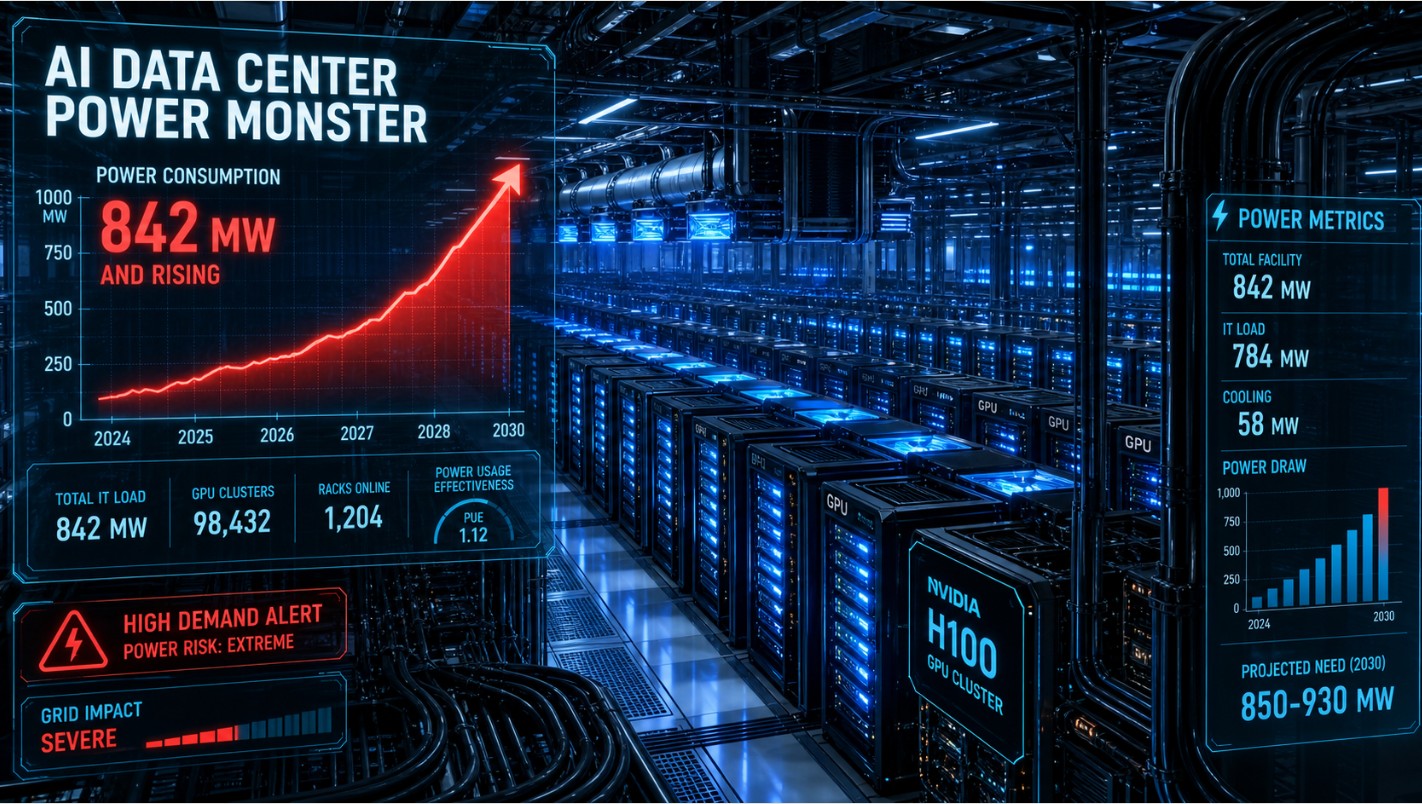
To understand why AI is different from everything the grid has faced before, you need to appreciate the sheer difference in scale between conventional data centers and AI facilities.
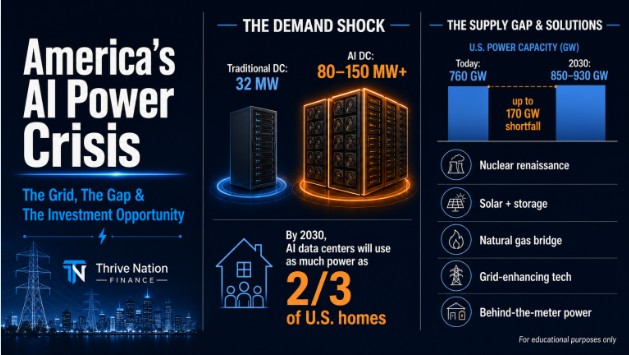
A traditional data center, the kind running websites, email servers, and basic cloud computing, uses around 32 megawatts of electricity. That is significant, but manageable. Grid operators understand it and plan for it.
An AI data center running the GPU clusters needed for large language model training and inference is a completely different machine. These facilities consume between 80 and 150 megawatts as a baseline. The newest hyperscale AI campuses being built right now are targeting 500 megawatts and above. Microsoft and OpenAI’s Stargate Project, a single AI campus, is targeting up to 10 gigawatts of power. To put that in perspective, that is roughly the combined electricity consumption of New York City and San Diego.
The numbers that have emerged in 2026 make the scale even more visceral. By 2030, AI data centers alone will consume the same amount of electricity currently used by two-thirds of all American homes. By 2035, Deloitte estimates that AI data centers in the United States alone could consume 123 gigawatts, up from just 4 gigawatts in 2024. That is a thirtyfold increase in just over a decade. The International Energy Agency forecasts that global data center electricity demand will nearly double to 945 terawatt hours by 2030, with the United States accounting for close to half of that total.
Five individual data center facilities are expected to cross the gigawatt threshold in 2026 alone — meaning single campuses consuming more electricity than entire cities. The United States currently hosts over 4,200 data centers, and the construction pipeline shows no sign of slowing.
The grid is already showing signs of serious strain. The U.S. Energy Information Administration confirmed in May 2026 that American power consumption, which already hit a record high in 2025, will set new record highs in both 2026 and 2027, driven primarily by AI. In July 2024, a voltage fluctuation in Northern Virginia, the largest data center market in the world, caused the simultaneous disconnection of 60 data centers at once, triggering emergency grid adjustments across the region. It was not a catastrophe, but it was a warning. The infrastructure was not designed for this.
Making matters worse, AI data centers also consume enormous amounts of water. The chips that power artificial intelligence generate heat at densities that traditional air-cooling systems cannot manage. Modern AI server racks can generate more than 120 kilowatts of heat per rack, compared to 5 to 10 kilowatts in a conventional cloud facility. Keeping these machines cool requires either massive quantities of chilled water, liquid cooling systems that run directly through the chips, or both. A single large AI data center can use millions of gallons of water per day. This is a growing source of conflict in the water-stressed regions of Texas, Arizona, and Nevada where much of this infrastructure is being built.
A New Warning from America’s Grid Watchdog
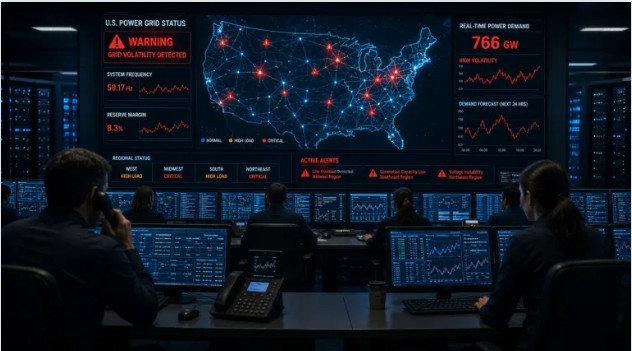
In May 2026, the crisis reached a new level of official urgency. The North American Electric Reliability Corporation (NERC) is the independent body responsible for ensuring the reliability and stability of the North American power grid. It is not an advocacy group. It is the grid’s own watchdog. In early May 2026, NERC issued a formal alert warning that AI data centers are now threatening grid stability in a way that goes beyond simple supply shortages.
The problem NERC identified is distinct and deeply concerning. AI computing workloads do not consume electricity at a steady, predictable rate. They swing violently between extremely high consumption during active processing and near-zero consumption during idle periods and these swings can happen within seconds. NERC warned that these rapid power fluctuations leave grid operators “little or no room for real-time responses,” meaning that in a worst-case scenario, entire regional grids could be destabilized by the erratic power behavior of large AI campuses.
This is a fundamentally different kind of risk than a simple supply shortage. A supply shortage can be planned for and managed gradually. A stability threat can materialize in seconds, with cascading consequences across an entire region. The NERC alert has triggered emergency planning sessions across utilities nationwide and adds significant urgency to the technology solutions being developed to give AI data centers more predictable, controllable load profiles.
How Much New Generation Is Actually Needed?
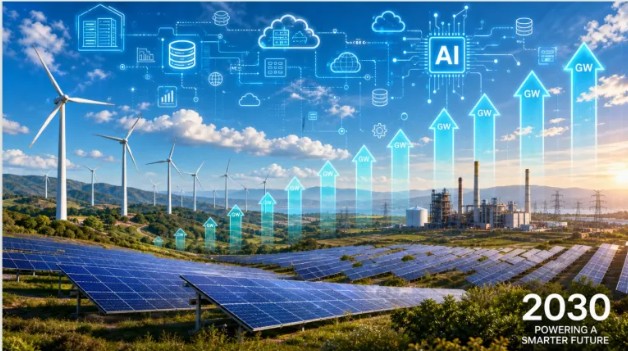
The gap between what the U.S. grid can currently deliver and what will be required by 2030 is staggering when expressed in concrete numbers.
American peak electricity demand, the highest moment of grid stress, currently sits at around 760 gigawatts. By 2030, that figure is projected to rise to between 850 and 930 gigawatts, creating a supply gap of 90 to 170 gigawatts that must be filled in just four years. To put 170 gigawatts in perspective, that is roughly equivalent to building 170 large nuclear power plants in four years, an obviously impossible task using conventional methods.
The supply response is being led by solar energy, which is expected to add approximately 40 gigawatts of new capacity annually through 2030. Grid-scale battery storage is scaling alongside solar at roughly 15 gigawatts per year, providing the ability to store daytime solar generation for use after sunset. Natural gas plants are expected to contribute an average of 21 gigawatts per year starting in 2027, once turbine manufacturing backlogs begin to clear. A record 86 gigawatts of new electricity generation capacity was already planned for 2026 and is the largest single-year addition in American history.
However, there is an important nuance that investors and readers should understand. Solar power operates at roughly a 25 percent capacity factor meaning 40 gigawatts of installed solar panels delivers the equivalent of only about 10 gigawatts of round-the-clock power when averaged across days and seasons. AI data centers need firm power close to 24 hours a day, every day. This mismatch between the speed of solar deployment and the always-on requirements of AI is precisely why natural gas and nuclear remain indispensable, and why companies positioned in those sectors represent such durable long-term investments.
Why the Solution Takes So Long
The maddening reality of this crisis is that the solutions exist. America knows how to build power plants. It knows how to string transmission lines. The problem is not knowledge, it is time.
Building a new high voltage transmission line in the United States takes between 10 and 20 years from initial planning to energization. Environmental reviews, land acquisition, community opposition, state regulatory approvals, and federal permitting requirements stack on top of each other in a process that has barely changed since the 1970s. The country needs to build 5,000 miles of new high-capacity transmission lines every year through 2035 to keep up with projected demand. In 2024, it built 888 miles.
New power plants face similar timelines. A new nuclear facility can take 15 to 20 years to license and build. A large natural gas plant takes three to four years at minimum and that timeline has stretched because global turbine manufacturers are overwhelmed with orders, with delivery backlogs stretching nearly three years. Even transformers the basic hardware that every substation requires, now have lead times of nearly three years, up from about a year before the AI boom began.
Meanwhile, AI companies want power now. Not in 2030. Not in 2035. Now. Today, 50 percent of U.S. data center builds planned for 2026 are already delayed or cancelled due to simple power unavailability. The gap between what AI demands and what the grid can currently deliver is the central economic tension of our time.
Adding to the institutional complexity, in May 2026 American Electric Power, one of the largest utilities in the country, threatened to withdraw from two of America’s biggest power grids over disputes about who should bear the costs of data center-driven grid upgrades. When utilities themselves are in open conflict with grid operators over the financial burden of the buildout, it signals how deep the structural tensions now run.
Residents are also starting to feel the impact directly. Maryland’s state energy agency warned in May 2026 that residents could face a collective 1.6 billion dollars in higher electricity bills over the next decade to subsidize grid upgrades driven by data center expansion. The same dynamic is playing out across eight of the nine largest data center markets in America. The AI power crisis is no longer an abstract infrastructure problem but it is beginning to show up in household budgets.
The Race to Solve It
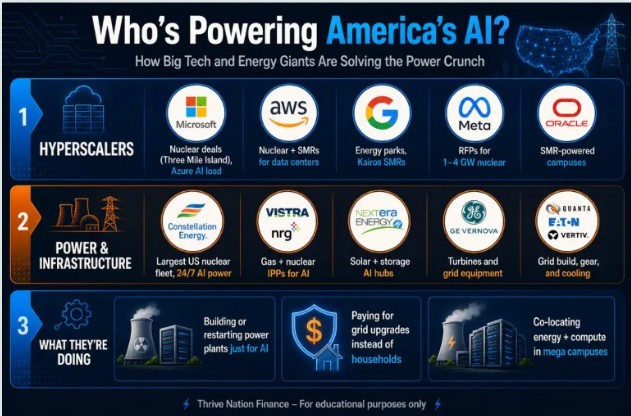
What makes this story genuinely exciting for investors and for the country is the breadth and creativity of the response.
The most dramatic development is the nuclear renaissance. Every major technology company in America has placed a major bet on nuclear energy in the last two years. Microsoft signed a 20-year, 16 billion-dollar agreement to restart Three Mile Island in Pennsylvania. Amazon has committed more than 20 billion dollars to co-locate AI campuses directly with nuclear plants, including the Susquehanna facility, and has set an overall target of securing five gigawatts of new nuclear capacity. Google signed the world’s first-ever corporate fleet agreement for small modular reactors with Kairos Power and has committed 40 billion dollars to three new data center campuses in Texas. Meta put out a request for proposals for up to four gigawatts of new nuclear capacity. Oracle secured building permits for three small modular reactors to power a gigawatt-scale data center campus.
The nuclear momentum has also reached the federal government. President Trump signed four executive orders in early 2026 specifically designed to accelerate nuclear energy deployment across the United States, targeting a dramatic reduction in the time it takes to license and permit new nuclear facilities. The combination of Big Tech demand, private investment, and federal policy support has created the most favorable environment for nuclear energy in America since the 1970s.
More recently, an emerging generation of companies is broadening the nuclear story beyond the hyperscalers. Riot Platforms and Terrestrial Energy announced a partnership in May 2026 to co-develop Generation IV Integral Molten Salt Reactor technology specifically for large-scale data centers, with candidate sites in Texas and Kentucky. The nuclear renaissance is no longer the exclusive domain of Microsoft and Google, it is spreading across the entire computing industry.
Nuclear’s appeal is not ideological, it is practical. Unlike solar and wind, nuclear power runs around the clock regardless of weather. AI data centers cannot tolerate gaps in power supply. The models don’t stop training because clouds block the sun. Nuclear provides the always-on, carbon-free baseload power that no renewable source can currently match at scale.
That said, even Microsoft, one of the most aggressive nuclear advocates, is facing a genuine internal dilemma. As of May 2026, the company is privately debating whether to delay its pledge to match 100 percent of its hourly energy use with clean power by 2030, because the pace of its AI data center buildout is outrunning the availability of clean energy. This is a candid admission that the urgency of AI growth is forcing even sustainability-committed corporations to prioritize electrons over environmental pledges in the near term. It makes the nuclear argument stronger, not weaker because nuclear is the only scalable clean energy source that runs continuously.
For faster near-term relief, the industry is deploying renewables paired with large battery storage systems, which can be built and connected in under two years. Companies like Bloom Energy are installing on-site fuel cells at data center campuses, generating electricity directly on location without waiting for grid interconnection. Chevron and GE Vernova have partnered to deploy modular natural gas generation systems at AI campuses within 18 to 24 months.
Engineers are also extracting more capacity from the existing grid without building new lines. Technologies called Dynamic Line Ratings use sensors on existing transmission towers to detect real-time weather conditions and allow operators to push significantly more power through lines that were previously underutilized. Advanced conductors replace old wires on existing towers to double or triple their capacity without requiring new rights-of-way or permits. These solutions can be deployed in months and are providing critical breathing room while longer-term projects are built.
Google has also pioneered something genuinely innovative: using AI itself to manage data center power consumption. Under agreements with utilities in Indiana and Tennessee, Google can throttle its machine learning workloads during grid stress events, releasing capacity back to the grid within seconds. The technology that causes the crisis is also helping to manage it.
How China Compares And Why It Should Concern Every American Investor
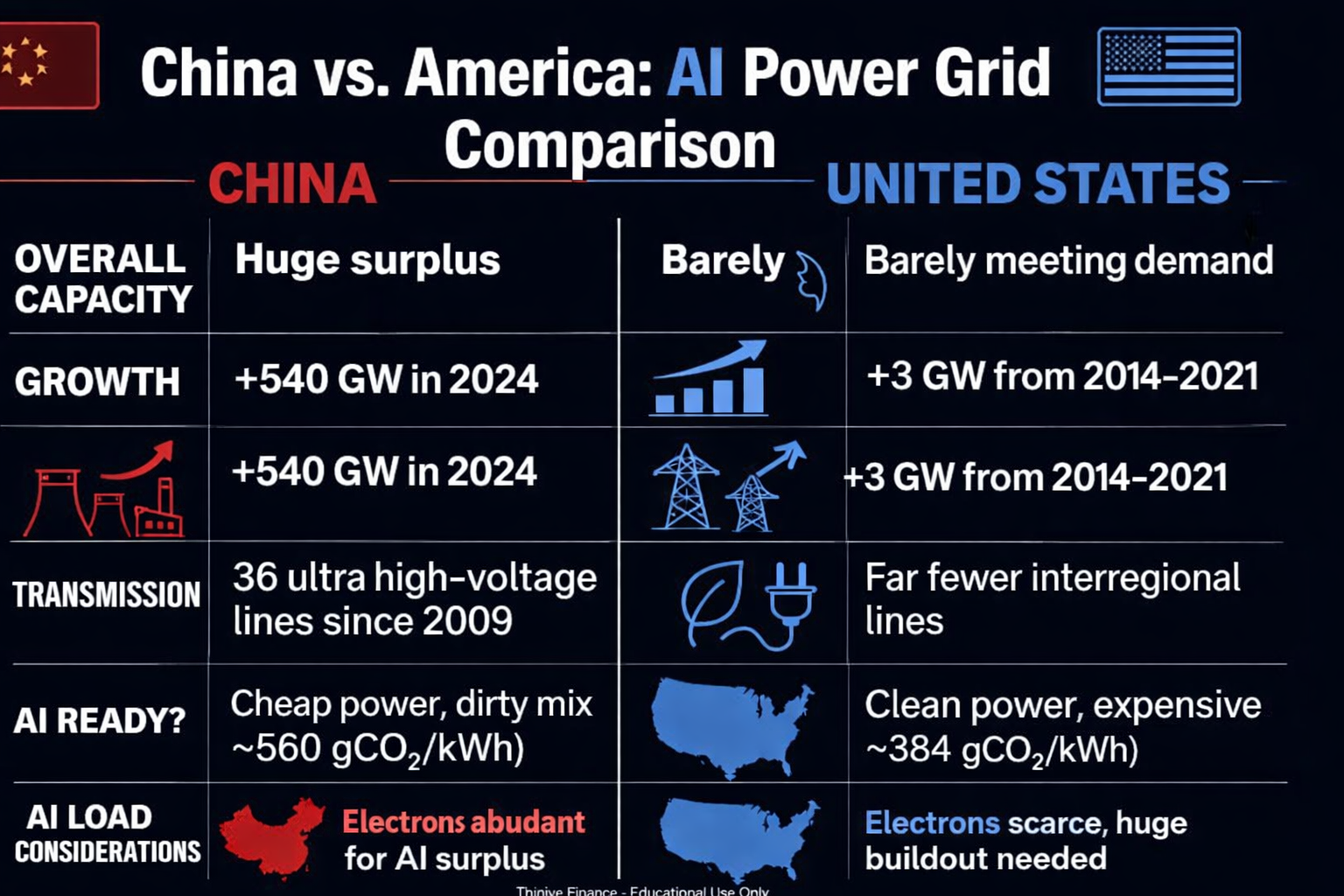
You cannot fully understand America’s power crisis without looking across the Pacific.
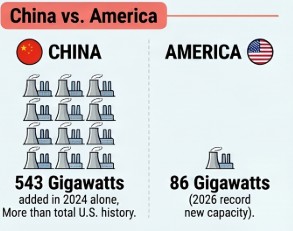
China has spent the past 25 years deliberately overbuilding its power infrastructure. In 2024 alone, China added 543 gigawatts of new electricity generation capacity; more than the entire cumulative installed capacity ever built in the history of the United States. China generates more than twice as much electricity as America and consistently maintains a reserve margin of 80 to 100 percent, meaning it always has roughly double the electricity capacity it currently needs. When AI data centers arrived needing enormous amounts of power quickly, China had the surplus to absorb them.
American AI experts who visited China in 2025 came back, in the words of Fortune magazine, “stunned” by the comparison. The U.S. grid is so far behind that experts have begun using the term “electron gap” to describe the strategic disadvantage, the idea that America’s lead in AI model development and chip design could be neutralized if American data centers simply cannot get power fast enough.
Chinese data centers also pay electricity prices that are less than half of what American data centers pay in many regions. Every major U.S. tech company has significant data center investments outside America partly as a hedge against domestic power constraints. Every megawatt built overseas instead of in America represents GDP, jobs, and tax revenue that does not come home.
This is not merely a business problem. It is a national security issue, and it is increasingly being treated as one at the highest levels of the U.S. government.
The Economic Prize at Stake
The scale of investment being mobilized to solve this crisis is genuinely historic.
Global spending on data center infrastructure is projected to approach one trillion dollars by 2030, with an additional 1.3 trillion dollars earmarked specifically for power generation and energy infrastructure to support it. U.S. utilities have committed 1.1 trillion dollars in capital expenditure between 2025 and 2029. The grid reconstruction alone is expected to create more than 1.24 million construction and engineering jobs. The largest technology companies are pouring capital into this buildout at a pace that has no historical precedent in the private sector.
Beyond the construction activity, the productivity gains from AI itself, once the power to run it is secured, could be transformational. Goldman Sachs estimates that AI could add seven percentage points to global GDP over a decade. McKinsey puts AI’s potential annual economic contribution at between 2.6 and 4.4 trillion dollars globally. The Department of Energy estimates that grid modernization alone would save American consumers over 100 billion dollars in electricity costs by 2050.
This is not speculative. It is structural. The grid must be built regardless of which AI model wins the arms race, regardless of which political party controls Washington, and regardless of short-term economic cycles. Physical infrastructure at this scale, once initiated, does not stop until it is complete.
The Investment Landscape: Who Wins and Who Doesn’t

Not every company that appears connected to this theme will benefit equally. History is full of examples, from railroads to internet infrastructure to shale energy, where the macro story was correct but most individual stocks underperformed while a concentrated group of well-positioned businesses generated extraordinary returns.
The most durable investment positions in this super cycle are in what investors call the “picks and shovels” layer, companies that are mandatory regardless of which technology wins. The companies that build the wires, manufacture the equipment, generate the power, and mine the raw materials win under every scenario. They do not need to pick the right AI model. They do not need to guess whether nuclear or solar dominates. They simply need to exist and execute while the world builds around them.
Investors should also be mindful of risk. Some of the companies most closely associated with this theme have already delivered extraordinary stock price gains of 130, 200, even 400 percent in some cases. Stocks that have run that far embed significant optimism into their prices, and even a small disappointment relative to expectations can cause sharp short-term declines. The wisest approach is to build positions gradually, diversify across the full infrastructure stack, and prioritize companies with real earnings growth and real multi-year contracts rather than speculative stories built on possibilities alone.
With those principles as the foundation, here are ten companies that appear well-positioned for mid to long-term investors.
10 Companies to Consider for Mid to Long Term Investment
1. Quanta Services (PWR)
Quanta is the largest electric infrastructure contractor in North America. It builds transmission lines, substations, and renewable energy connections across the country. More than 80 percent of its revenue comes from electric infrastructure, and its project backlog grows every single quarter. With America needing 5,000 miles of new transmission annually through 2035, Quanta has close to a decade of demand visibility baked into its order book. This is the most direct pure-play on the physical grid buildout, the company that literally builds the wires America needs.
2. GE Vernova (GEV)
GE Vernova’s installed base of turbines and generators produces approximately 25 percent of the world’s electricity. Its gas turbine backlog has tripled since 2023. Its grid equipment division is running at capacity with a growing order book. It has exposure to wind energy, grid modernization software, and gas generation simultaneously making it one of the most diversified and durable infrastructure names available to investors. When the world needs power, it tends to need GE Vernova equipment.
3. Constellation Energy (CEG)
Constellation operates the largest nuclear fleet in the United States and has locked in long-term power supply contracts with Microsoft and Meta for AI data center energy. The federal government’s four nuclear executive orders in 2026 directly support Constellation’s business environment and reduce the regulatory uncertainty that previously weighed on the sector. Nuclear’s combination of 24/7 reliability, zero carbon emissions, and fixed fuel costs makes it uniquely valuable in the AI era, and Constellation’s contracted revenue stream provides exceptional earnings visibility stretching well into the next decade.
4. NextEra Energy (NEE)
NextEra is the world’s largest generator of electricity from wind and solar. It is developing dedicated AI power hubs and has signed power supply agreements with Google, Meta, and others at significant scale. It pays a dividend that grows at approximately 10 percent annually, a combination of reliable income and infrastructure growth that is rare in any sector. It is currently trading at historically discounted valuations relative to its growth rate, which makes the entry point more attractive than it has been in years.
5. Eaton Corporation (ETN)
Eaton manufactures the power management hardware that every data center, substation, and transmission upgrade requires i.e. circuit breakers, switchgear, transformers, and power distribution units. It co-designed an 800-volt direct current power architecture specifically for AI rack deployments with NVIDIA. Virtually every major data center built in America contains Eaton equipment somewhere. It is a quieter, steadier compounder than the headline names, but its role in the infrastructure stack is irreplaceable and its revenue visibility is outstanding.
6. Vertiv Holdings (VRT)
Vertiv builds the critical power and cooling infrastructure that lives inside data centers; uninterruptible power supplies, liquid cooling systems, power distribution units, and microgrid solutions. Its entire product line has been redesigned for the extreme power density requirements of AI hardware, and it has delivered more than 30 percent annual revenue growth as data center construction accelerates globally. It sits precisely at the intersection of the power problem and the cooling problem, making it a dual beneficiary of the AI infrastructure boom.
7. Williams Companies (WMB)
Williams operates one of the largest interstate natural gas pipeline networks in the United States and is actively positioning itself as a direct power supplier to AI data center developers. As more hyper-scalers turn to on-site natural gas generation to bypass grid interconnection queues, proximity to major pipeline infrastructure has become a critical factor in data center site selection. Williams offers a dividend yield of approximately 3.5 percent with multi-year contracted cash flows, a strong combination of income and strategic positioning that suits long-term investors.
8. Freeport-McMoRan (FCX)
Copper is the material that makes the entire electrification story possible. Every transmission line, transformer, electric vehicle, solar panel, wind turbine, and data center requires significant quantities of it. Freeport is the largest copper producer in the United States and one of the largest in the world. Copper demand is projected to significantly outstrip supply by 2027 as grid expansion, electrification, and data center construction all compete for the same metal simultaneously. This is a commodity play with structural demand tailwinds that extend well beyond AI alone.
9. Cameco Corporation (CCJ)
Uranium is the fuel of the nuclear renaissance, and Cameco is one of the world’s premier uranium producers. As nuclear plant restarts and new small modular reactor constructions multiply over the next decade, accelerated now by four federal executive orders, uranium demand is entering a structural bull market with years of runway. Cameco also provides nuclear fuel services and holds a stake in Westinghouse, giving it exposure across the entire nuclear value chain from the mine to the reactor to the fuel processing facility. For investors who believe in the nuclear thesis, Cameco is the most direct way to own the fuel that makes it possible.
10. Equinix (EQIX)
Equinix is the world’s largest data center REIT, operating more than 280 facilities across five continents. It recently raised its dividend by 10 percent, projects revenues exceeding 10 billion dollars, and is investing between four and five billion dollars annually through 2029 to expand its capacity. As the physical landlord of the digital economy, Equinix benefits from every AI model, every cloud workload, and every enterprise digital transformation without needing to bet on which technology wins. It combines the stable income characteristics of real estate with the long-term growth characteristics of technology infrastructure.
A Word on Risk and Patience
Every one of these companies carries at least one of the following risks; market risk, regulatory risk, execution risk, and valuation risk. Some of these stocks have already risen significantly, which means that while the long-term thesis remains intact, short-term volatility is always possible. The wisest approach for a retail investor is to build positions gradually over time rather than committing all at once, maintain diversification across the full infrastructure stack rather than concentrating in one or two names, and focus on companies with real contracts and real earnings growth rather than speculative stories built on possibilities.
The most important principle is perhaps the simplest: great infrastructure themes reward patient investors who buy good companies at reasonable prices and hold them through the inevitable turbulence. The railroad barons who built 19th-century America made fortunes but so did the patient shareholders who held the steel companies, the telegraph operators, and the land developers that the railroad boom made valuable.
The AI power infrastructure super-cycle is the railroad moment of our generation. The wires are being strung. The plants are being built. The transformers are being ordered. The question is not whether this transformation will happen; it is already happening, right now, confirmed by government data, NERC alerts, and trillion-dollar corporate commitments. The question is whether you will be positioned to benefit when it does.
This article is for educational and informational purposes only and does not constitute personalized financial or investment advice. All investments carry risk, including the possible loss of principal. Always consult a qualified financial advisor before making investment decisions based on your individual circumstances.
Thrive Nation Finance empowers newcomers to Canada and ambitious investors with the financial knowledge to build lasting wealth. Explore our blog for guides on investing, insurance, and navigating the Canadian financial system.