
Bottleneck Investing: How Regular People Can Profit from Hidden Chokepoints in AI
Imagine a busy highway that suddenly narrows from four lanes down to one. This situation creates a visible bottleneck, as vehicles pile up and traffic slows significantly. The issue arises not because there are fewer cars on the road, but rather due to the inability of that narrow segment to accommodate the volume of vehicles attempting to pass through. This narrow stretch is known as the bottleneck, which in investing terms refers to a critical point within a new trend that restricts the overall growth of the system.

By Gabriel / May 9, 2026

Imagine a busy highway that suddenly narrows from four lanes down to one. This situation creates a visible bottleneck, as vehicles pile up and traffic slows significantly. The issue arises not because there are fewer cars on the road, but rather due to the inability of that narrow segment to accommodate the volume of vehicles attempting to pass through. This narrow stretch is known as the bottleneck, which in investing terms refers to a critical point within a new trend that restricts the overall growth of the system.
In the context of investing, a bottleneck represents the pivotal aspect of a burgeoning trend, such as artificial intelligence (AI), that constrains the rate at which the entire system can expand. When resources in this area are limited and challenging to replace, companies that manage to control these resources can generate substantial profits. Today, within the realm of artificial intelligence, the focus of this bottleneck is increasingly shifting towards memory – specifically, the chips responsible for storing and transferring data.
This article aims to elucidate several key concepts in straightforward language. These will include: understanding what “bottleneck investing” entails, why memory has emerged as the new bottleneck in AI, a plain explanation of High Bandwidth Memory (HBM), the types of companies that stand to benefit from this trend, and how a novice investor can strategically position themselves in this evolving landscape.
1. What is “bottleneck investing”?
Simple idea
Bottleneck investing refers to the strategy of identifying the segment of a significant trend that is impeding overall progress and subsequently investing in the companies that are addressing this issue. Rather than pursuing the most talked-about names in the industry, this approach encourages investors to seek out the chokepoints upon which the entire sector relies. By focusing on these critical areas, investors can potentially reap greater rewards as these bottlenecks are relieved.
A simple story: the gold rush
During the historical gold rush, the majority of individuals sought wealth by digging for gold itself, but many faced failure in their endeavors. However, a select few attained wealth by providing essential tools such as picks, shovels, and other basic supplies to the miners. These suppliers profited regardless of whether any individual miner struck gold. This scenario gives rise to the well-known “picks and shovels” investing concept.
Instead of wagering on which miner would find gold, these investors placed their bets on the indispensable tools that every miner would need, regardless of the outcome. Bottleneck investing can be viewed as an evolved version of this concept: it emphasizes the necessity of identifying the most scarce and crucial elements within a trend. This approach focuses on companies that either control or alleviate the identified bottleneck, positioning them as key players in the market.
2. Why bottlenecks matter in big trends
Emerging trends such as AI, electric vehicles, and green energy can be likened to massive waves that surge forward. Initially, there is widespread excitement as investors rush to acquire shares in the most visible winners, such as prominent AI software companies. However, the true financial gains often flow toward the underlying inputs that are in limited supply, the infrastructure upon which everything else depends, and the essential tools and components that cannot be easily substituted.
When a particular aspect becomes a bottleneck, several phenomena occur: demand continues to escalate, while supply struggles to keep pace with this growth. Customers become increasingly willing to pay higher prices for access to these scarce resources. Consequently, companies that manage to control these bottlenecks can enjoy elevated profits and margins for an extended period. This dynamic is precisely what is beginning to unfold in the realm of AI memory.
3. A simple mental picture of AI and memory
To grasp the workings of AI in an uncomplicated manner, we can create a basic analogy without delving into complex mathematics. Imagine an AI system as a bustling restaurant kitchen, where various components work together to create efficient operations.
Visual: AI as a busy kitchen
In this analogy, the chef represents the GPU or AI chip, which performs the actual “cooking.” The ingredients symbolize the data and model information that the chef needs to work with, while the pantry and fridge represent the memory and storage areas where these ingredients are kept. The speed and talent of the chef are significant, but if the pantry is located too far away, if the fridge is too small, or if the helpers slow down in delivering ingredients, the chef will end up spending an excessive amount of time waiting instead of cooking.
This waiting time illustrates the memory bottleneck; the system’s performance is not limited by the chef’s capabilities but rather by how efficiently the ingredients can be accessed and utilized. In the context of AI, this bottleneck is a critical factor that affects the overall speed and effectiveness of the system.
What’s happening in real AI systems
Modern AI applications, including large language models and image generation technologies, require the constant movement of vast amounts of data in and out of memory. Over recent decades, there’s been a significant disparity in the growth rates of computing speed and memory speed.
For instance, one study revealed that over a span of approximately 20 years, the speed of chips, or compute power, increased about 600 times faster than memory bandwidth. Another analysis indicated that in the field of AI, chip performance tripled within two years, while memory bandwidth grew only about 1.6 times during the same period, and network bandwidth increased by approximately 1.4 times.
This gap in performance creates a situation where expensive AI chips often remain idle, waiting for data, rather than operating at full capacity. This phenomenon is referred to as the “memory wall,” which is a significant issue that the AI industry is currently confronting.
4. What is High Bandwidth Memory (HBM)?
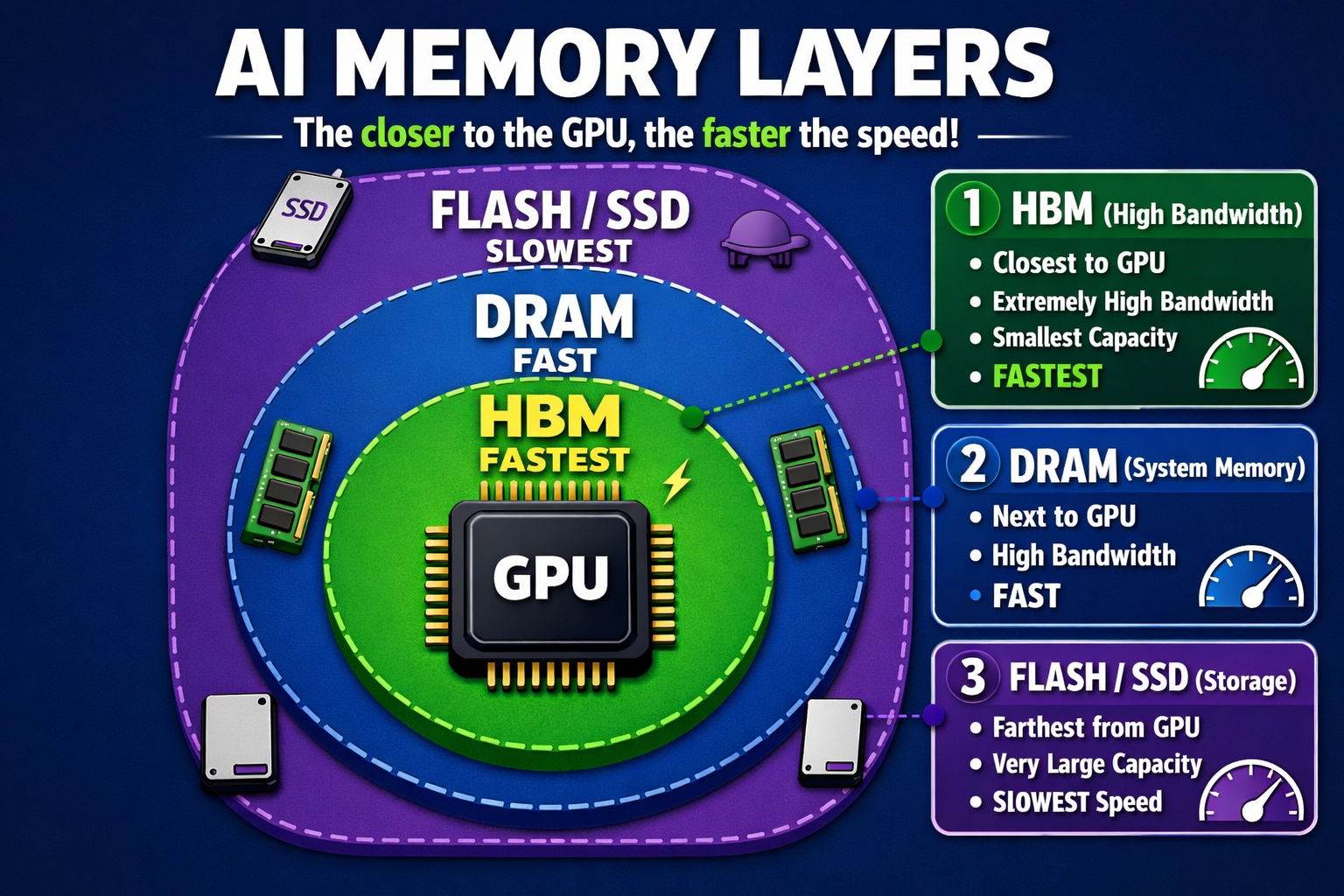
To understand High Bandwidth Memory (HBM), we can break it down into simple terms. Most computers utilize multiple layers of memory, each serving a distinct purpose in terms of speed and data storage.
Normal memory vs HBM
Typically, computers use different types of memory: standard RAM (such as DDR or DDR5), which is fast but not sufficiently close to the chip; graphics memory (GDDR), employed in graphics cards and faster than regular RAM; and storage solutions (like SSDs and hard drives) that, although much slower, can hold larger quantities of data.
High Bandwidth Memory (HBM) is a specialized form of memory designed to be situated extremely close to the processor, enabling rapid data transfer while consuming less power. This innovative design allows HBM to efficiently support the demanding requirements of modern AI applications.
Visual: Memory as buildings in a city
To illustrate this concept further, imagine traditional memory as low-rise buildings spread out over a large area. In contrast, HBM can be likened to a tall skyscraper constructed right next to a factory that requires constant access to materials. Instead of relying on trucks that travel long distances, everything in this analogy is stacked vertically, allowing elevators, or through-silicon vias, to quickly transport materials up and down.
HBM employs a 3D stacking technique, where multiple memory chips are layered on top of one another, connected by tiny vertical links known as TSVs. This configuration is placed adjacent to the GPU or AI chip, resulting in a significant reduction in the distance data must travel. Furthermore, it creates wide highways for data transfer, delivering substantial bandwidth in a compact space.
Consequently, HBM is increasingly utilized in high-end GPUs for AI, supercomputers, and other advanced chips that require rapid data movement. This trend highlights the growing importance of HBM in addressing the memory bottleneck within the AI industry.
5. Why memory is the new bottleneck in AI
For many years, the primary bottleneck in AI development was compute power, defined by the number of operations per second that chips could execute. However, as AI models expand in size and context windows lengthen, the challenges associated with memory have come to the forefront.
Currently, the amount of data that must be stored and transferred has surged dramatically, and the speed at which this data must travel has also increased exponentially. Analysts and research organizations are now asserting that memory has become the new bottleneck in AI semiconductors, indicating that AI performance is increasingly constrained by memory access rather than solely by processing power.
In practical terms, this translates to AI models often failing to operate at peak efficiency because they are left waiting for data from memory. AI data centers now require progressively more advanced DRAM and HBM to meet growing demands, shifting the industry’s focus from a compute arms race to a memory arms race.
This shift embodies the core opportunity in bottleneck investing: as AI cannot continue to expand without addressing the memory bottleneck, companies that manufacture and supply the necessary memory are positioned advantageously to capitalize on this trend.
6. The global “memory squeeze”
The rapid surge in AI demand has resulted in a significant portion of global memory production, including DRAM and HBM, being redirected towards AI data centers. This diversion has created a global memory supply squeeze, characterized by tight capacity and long lead times for orders.
Market research and commentary indicate that AI servers require considerably more memory per machine compared to standard servers. Large language models, for instance, necessitate vast amounts of DRAM and HBM to store weights and manage lengthy interactions. The memory market is currently experiencing a capacity-constrained phase that is expected to persist at least through the mid-2020s, with strong order visibility.
In straightforward terms, there is a substantial demand from AI customers for advanced memory, yet the supply isn’t sufficient to meet this demand swiftly. When such discrepancies arise in any industry, a typical outcome is that prices tend to rise, contract lengths extend, and suppliers enjoy improved profits and margins. This behavior exemplifies the classic characteristics of a bottleneck.
7. Who benefits from the AI memory bottleneck?
Now, let’s explore the types of companies that stand to gain from the memory bottleneck in AI, without delving into specific stock recommendations.
Memory chip makers (DRAM, HBM, NAND)
These are the firms that are responsible for manufacturing memory chips, including DRAM (short-term working memory), HBM (high-bandwidth, stacked memory), and NAND/flash (long-term storage such as SSDs). A limited number of companies possess the capability to produce HBM at the high quality and scale that AI demands.
The complexity of HBM manufacturing, which involves advanced stacking and packaging techniques, limits the number of producers in the market. Due to the high demand and restricted supply, these companies can raise prices, prioritize their best customers, and experience profit growth that outpaces their sales volumes.
For novice investors, the essential takeaway is that memory has transitioned from being a mundane commodity to a strategic bottleneck and profit center within the AI sector.
GPU and AI chip makers that use HBM
AI chips, particularly high-end GPUs, are intricately designed to work in conjunction with HBM. Each new generation of chips incorporates additional HBM stacks, leading to increased memory bandwidth per chip. The performance of these chips in real-world applications is heavily dependent on the memory that is integrated with them.
As memory becomes the bottleneck, the value of GPU + HBM systems rises significantly. Chip manufacturers that can secure a sufficient supply of HBM gain a competitive advantage, as their customers are willing to invest in complete systems that effectively address memory-related challenges.
In essence, some AI chip companies emerge as bottleneck winners, as they find themselves at the center of the GPU + HBM ecosystem, benefiting from this critical intersection.
Storage and data-pipeline specialists
The memory bottleneck extends beyond chips located adjacent to the GPU; it also encompasses the efficiency of data movement from storage solutions, such as SSDs and flash memory, into RAM. The overall design of the system plays a crucial role in ensuring that GPUs remain active rather than idle.
Companies that specialize in software and hardware solutions are developing technologies aimed at making flash storage function more like an extension of memory, enabling faster streaming of training data and model checkpoints. By resolving these data bottlenecks, they help ensure that GPU utilization remains high.
These firms benefit from the ability of AI customers to accomplish more tasks with the same GPUs, effectively “creating more compute” without the need for additional chip purchases. For beginner investors, understanding this trend is vital for recognizing potential opportunities in the evolving AI landscape.
Some companies don’t manufacture memory chips themselves, but they effectively alleviate memory and storage bottlenecks through innovative designs. These companies play a crucial role in the landscape of bottleneck investing, as they contribute to resolving the limitations that hinder overall performance in technology systems. By utilizing strategic engineering and design approaches, they enhance the efficiency of data handling and processing capabilities. This not only benefits their operations but also positions them as significant players in a competitive market. Thus, recognizing and understanding these entities is essential for investors looking to navigate the complexities of bottleneck investing.
8. How bottleneck investing helps you avoid hype

For a beginner, it’s easy to get entangled in the excitement of trends driven by:
- The loudest AI stocks that are trending on social media platforms
- Short-term price spikes that may seem enticing
- Fear of missing out (FOMO), which often clouds judgment
Bottleneck investing encourages you to slow down and think differently about your investment approach:
- Start with the trend, not merely a ticker symbol.
- For example, consider that “AI will likely continue to grow for many years ahead.”
- Ask yourself: what is holding this trend back?
- Currently, the primary constraints are related to memory and data movement, rather than just the number of GPUs available.
- Map the key inputs and tools involved in the trend.
- Key components include memory chips, advanced packaging technologies, storage systems, networking solutions, power management, and cooling systems.
- Look for real constraints affecting the market.
- Consider factors such as the limited number of suppliers, the long lead times required to build new factories, and the persistent strong demand, even when prices rise.
- Finally, choose how to invest based on your findings.
- You might invest in broad ETFs that offer exposure to various bottleneck players, or consider a small basket of memory-related stocks, or even complementary “picks and shovels” in equipment and infrastructure.
This approach shifts your mindset from:
- “What stock is hot this week?”
- To: “Where does the system have to send money for years because it has no choice?”
That second question is far more powerful.
9. How a beginner can position themselves
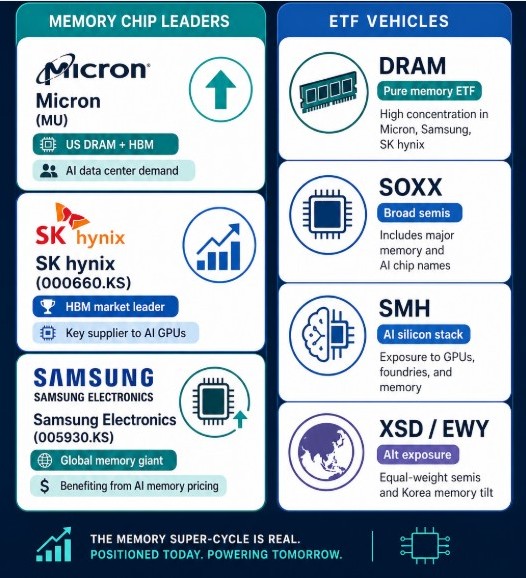
This is general education and not personalized advice, but here’s a simple framework you can adapt to your investment strategy.
Step 1: Keep a strong, boring core
Even with an exciting theme like AI memory, most beginners should prioritize:
- Keeping the majority of their capital in diversified funds to mitigate risk.
- Utilizing broad index ETFs (such as those covering global stocks, total market, or broad technology sectors) as the foundational element of their portfolio.
This strategy serves to protect you if:
- The AI memory story takes longer to evolve than anticipated.
- The market cycle turns sooner than expected.
- Individual stocks prove to be more volatile than you can emotionally withstand.
Step 2: Make AI/memory a “satellite”
Instead of going “all in,” consider AI memory as a satellite position:
- This would be a smaller slice of your portfolio specifically focused on this significant idea.
- The size of this allocation should depend on your risk tolerance, investment horizon, and confidence in the theme.
For example (illustrative only):
- 70–85% in broad, diversified funds
- 15–30% in thematic investments, including AI and semiconductors.
- Within that 15–30%, only a portion should be allocated directly to memory or bottleneck-related companies.
The exact numbers are subjective, but the principle is:
Let the AI memory idea enhance your wealth, rather than dictate your entire financial future.
Step 3: Prefer baskets and ETFs over single hero bets
As a newcomer to investing, selecting a single stock can be fraught with risk. Instead, it is wise to look for ways to spread your investment across multiple options:
- Consider semiconductor or AI infrastructure ETFs.
- These usually encompass a variety of chip and memory companies, allowing you to benefit if the entire ecosystem experiences growth.
- This broad exposure helps mitigate risk and capitalizes on overall market trends.
- Alternatively, consider regional or technology ETFs that include leaders in the memory sector.
- For instance, funds that hold major Asian and U.S. semiconductor companies often include leading memory manufacturers and AI chip producers.
By utilizing baskets of stocks:
- You can still gain from the bottleneck theme.
- You don’t have to accurately predict which single company will perform the best.
Step 4: Invest gradually, not all at once
AI and semiconductor markets are inherently volatile, with prices capable of fluctuating significantly within short periods.
For beginners, a straightforward tactic to manage this volatility is:
- Dollar-cost averaging (DCA) can be an effective strategy.
- Decide how much capital you’re willing to invest in the AI memory theme.
- Spread your investments over months or quarters, rather than making a single, large investment in one day.
This approach helps you:
- Avoid the pitfall of purchasing everything at a temporary market peak.
- Gain insights about the theme as you progress in your investments.
- Build emotional resilience to withstand volatility in the markets.
Step 5: Watch the bottleneck, not just the stock price
Since this is a bottleneck strategy, your investment “dashboard” should emphasize the bottleneck itself, including factors such as:
- Are reports consistently indicating that memory is the main AI bottleneck?
- Are memory manufacturers still discussing tight supply and strong demand?
- Are prices for HBM and DRAM rising, stable, or falling?
When:
- Capacity begins to catch up to demand.
- Prices level off or decline.
- Companies start stating that the market is “balanced” or “oversupplied.”
…that may indicate that the bottleneck phase is drawing to a close, and it could be time to slowly reduce your exposure or rebalance your portfolio back to your intended targets.
10. Turning this into plain action steps
Here’s a straightforward way to apply all of this as a novice investor:
- Learn the story (you are doing this now):
- Understand that AI growth is currently constrained by memory and data movement.
- Recognize that memory is not just a mundane component anymore; it has become a strategic chokepoint.
- Decide on your risk level:
- Consider how much of your total portfolio you are comfortable exposing to this particular theme.
- Ensure your answer allows you to sleep well at night.
- Choose your investment vehicles:
- Core: global or broad-market ETFs that provide a solid foundation.
- Satellite:
- A semiconductor or AI infrastructure ETF, plus
- (Optionally) a small basket of memory-heavy companies or related “picks and shovels” investments.
- Plan your buying schedule:
- Decide how frequently you plan to invest (monthly, quarterly).
- Stick to your plan instead of chasing short-term market moves.
- Review the bottleneck yearly:
- Once or twice a year, read a few brief updates regarding AI memory and HBM.
- Ask yourself:
- Is memory still the primary bottleneck?
- Are profits and demand still strong?
- Is supply beginning to catch up?
- Adjust slowly, not emotionally:
- If the bottleneck remains robust, you can maintain your satellite size steady.
- If evidence indicates that the bottleneck is easing, start to trim your investments gradually over time.