
Cerebras Systems IPO: What Every Retail Investor Needs to Know
If you’ve been paying attention to the stock market this week, you may have heard about a company called Cerebras Systems. Its stock ticker is CBRS, and it just made history as the biggest tech IPO of 2026. But what does that mean, and should you as a regular investor care? Let’s break it all down in plain English.

May 16, 2026

By Gabriel Gachange | Thrive Nation Finance
If you’ve been paying attention to the stock market this week, you may have heard about a company called Cerebras Systems. Its stock ticker is CBRS, and it just made history as the biggest tech IPO of 2026. But what does that mean, and should you as a regular investor care? Let’s break it all down in plain English.
What Is Cerebras Systems?
Cerebras is an American company founded in 2016 that makes AI chips, the special processors that power artificial intelligence applications like ChatGPT. Think of AI chips as the engine inside every AI product you use. Without them, AI cannot run.
For years, one company, Nvidia, has dominated this space. Nvidia has become one of the most valuable companies on earth because the world is hungry for its chips. But Cerebras believes it has built something better, at least for certain tasks.
Here’s the key difference: Nvidia builds chips the size of your thumbnail that must work together in large groups, like hundreds of workers in a factory passing materials between each other. Cerebras built a chip the size of an entire dinner plate; one massive chip that does the work all by itself without any passing around. For running AI models quickly, this approach can be up to 20 times faster than Nvidia’s approach.
What Happened at the IPO?
An IPO (Initial Public Offering) is when a private company opens its doors to the public for the very first time and lets everyday investors buy shares. Think of it as a company saying: “We’re growing fast. Want to own a piece of us?”
Cerebras set its opening share price at $185. That already valued the company at roughly $48 billion, not small at all. But investor demand was so overwhelming that when trading opened on May 14, 2026, the stock didn’t start at $185. It shot straight up to $350 per share, an 89% jump before most people had finished their morning coffee.
In fact, the demand was so intense that trading had to be temporarily halted because the price was moving too fast. By the end of the day, the stock settled at around $311, giving Cerebras a market value of approximately $95 billion. For context, that’s bigger than many household-name companies you’ve known for decades.
The company raised $5.55 billion in the process, the largest US tech IPO since Uber went public in 2019. Over 20 investors were competing for every single share available. That level of hunger is rare.
Why Was Demand So Explosive?
Several powerful forces combined to create this frenzy.
First, OpenAI, the maker of ChatGPT, publicly endorsed Cerebras. OpenAI’s head of compute called Cerebras “the best high-speed inference solution globally right now.” When the most famous AI company in the world says your product is the best, investors take notice immediately.
Second, Cerebras was already making money. Most tech companies go public while still losing millions every year. Cerebras came in with $510 million in revenue and $237 million in profits in 2025. That’s a company that has already figured out how to turn its technology into real cash.
Third, investors are desperately searching for “the next Nvidia.” Nvidia’s stock has grown by thousands of percent over the last decade. Many investors who missed that early opportunity are now hunting for the next big AI chip company to invest in before it becomes enormous. Cerebras arrived at exactly the right moment, with exactly the right story.
Fourth, the macro environment is perfect. Governments and corporations around the world are spending hundreds of billions of dollars building AI infrastructure right now. That money needs chips, and Cerebras has chips.
Who Are Cerebras’ Biggest Customers?
This is where the story gets both impressive and a little concerning.
On the impressive side, Cerebras counts OpenAI, Meta, Oracle, GSK (the pharmaceutical giant), Mayo Clinic, Mistral AI, Notion, and major national laboratories like Argonne in the United States and the Bavarian Supercomputing Centre in Germany as customers. These are not small or unknown names.
However, the concerning part is that one single customer, a UAE-based AI company called G42, backed by Microsoft, accounted for 87% of Cerebras’ revenue in 2024. That means almost all of the company’s income comes from one relationship in one country. If that relationship breaks down for any reason, including political tensions or export restrictions, the financial impact would be devastating.
This is called customer concentration risk, and it is one of the most important things to watch as Cerebras grows.
Can Cerebras Really Challenge Nvidia?
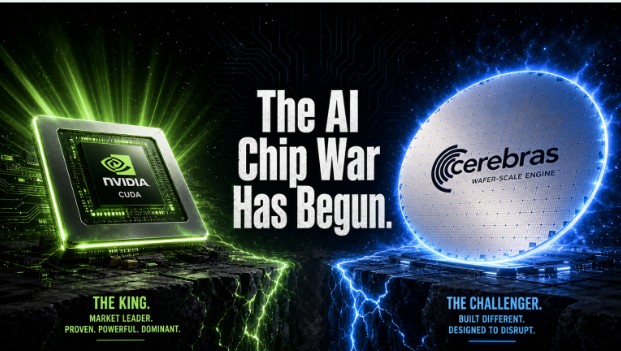
Honestly, the better way to think about this is not as a war where one company wins and the other loses. It’s more like two different specialists in the same field.
Nvidia is like a Swiss Army knife, incredibly versatile, works for almost everything AI-related, and has spent over a decade building software tools that millions of developers depend on. Switching away from Nvidia is not easy because the entire AI industry has been built on Nvidia’s software ecosystem, called CUDA.
Cerebras is more like a high-speed train, not ideal for every journey, but unbeatable when you need to move massive amounts of AI computation in one powerful, direct burst.
The realistic outcome is that both companies will thrive as the AI market continues to expand rapidly. There is enough demand for both architectures to co-exist profitably.
Is the Stock Worth Buying Right Now?
This is the question every retail investor is asking, and the honest answer is: probably not at this price, patience will serve you better.
Here’s the reality. When Cerebras’ stock opened at $350, institutional investors who got shares at the IPO price of $185 were already sitting on an 89% gain within minutes. As a regular investor buying at $311 or $330 today, you are starting your journey 68–78% behind where the big institutions started. That is a significant disadvantage built in before you’ve even pressed the buy button.
There is also the question of valuation. At a $95 billion market cap on $510 million in revenue, the stock is priced at roughly 186 times its annual sales. Nvidia, a far more established company, trades at around 25 to 30 times sales. For Cerebras to justify its current price, it needs to execute perfectly for years with almost no setbacks. That is a high bar for any company, let alone one that only went public 24 hours ago.
History also teaches us a hard lesson about hot IPOs. Companies like Snowflake, Rivian, and ARM all had explosive first-day gains and all fell dramatically in the months that followed before finding their real value. Most retail investors who chased those openings lost money before the stocks eventually recovered.
So What Should a Small Investor Actually Do?
Wait. Watch. Then act with discipline.
Here is a practical approach that respects both the opportunity and the risk:
Give the stock 4 to 8 weeks to cool down from the opening excitement. A pullback of 20 to 35% from current levels would bring CBRS closer to $200 to $250, a much more reasonable entry point with better upside potential.
Watch the first earnings report, expected in Q3 2026. This will be the most important test. It will show whether revenue is growing beyond G42, whether the OpenAI deal is delivering real income, and whether the company can maintain its profitability as it scales.
If you feel strongly about the company and don’t want to wait, consider a small starter position, perhaps one-third of whatever amount you plan to invest and add more only on price dips. Never put more into a single speculative stock than you can afford to lose entirely.
And always, always define your exit point before you buy. Decide in advance: if this stock drops to a certain level, I will sell and protect my remaining capital. That discipline separates investors from gamblers.
The Bigger Lesson Here
Cerebras is a genuinely exciting company with real technology, real customers, and real revenue. The AI chip market is one of the most important investment themes of our generation, and Cerebras has earned its place in that conversation.
But here is the wisdom that experienced investors live by: a great company and a great stock are not always the same thing at the same time. The best investment returns come not just from identifying the right company, but from buying it at the right price with the right patience.
The investors who will make real money in Cerebras are likely those who wait for the hype to settle, study the fundamentals carefully, and enter at a price that leaves room for growth, not those who rushed in on day one driven by the fear of missing out.
As always, invest in your education first. The returns on that never disappoint.
Gabriel Gachange is a licensed life insurance professional and financial educator at Thrive Nation Finance, helping newcomers and retail investors in Canada build wealth through financial literacy.
This article is for educational purposes only and does not constitute financial advice. Always consult a qualified financial advisor before making investment decisions.