
Copper at a Crossroads: Supply Constraints, Rising Demand, and How Retail Investors Can Participate Responsibly
This article explores why copper is becoming one of the world’s most important strategic metals. It explains how electric vehicles, renewable energy, power-grid expansion, artificial intelligence, and data centres are increasing long-term copper demand while declining ore grades, slow mine approvals, water shortages, geopolitical risks, and supply-chain bottlenecks make new supply difficult to bring online. It also gives retail investors a practical framework for gaining responsible copper exposure through diversified ETFs and selected mining companies, while managing the risks of commodity-price volatility, concentrated positions, and speculative investing.
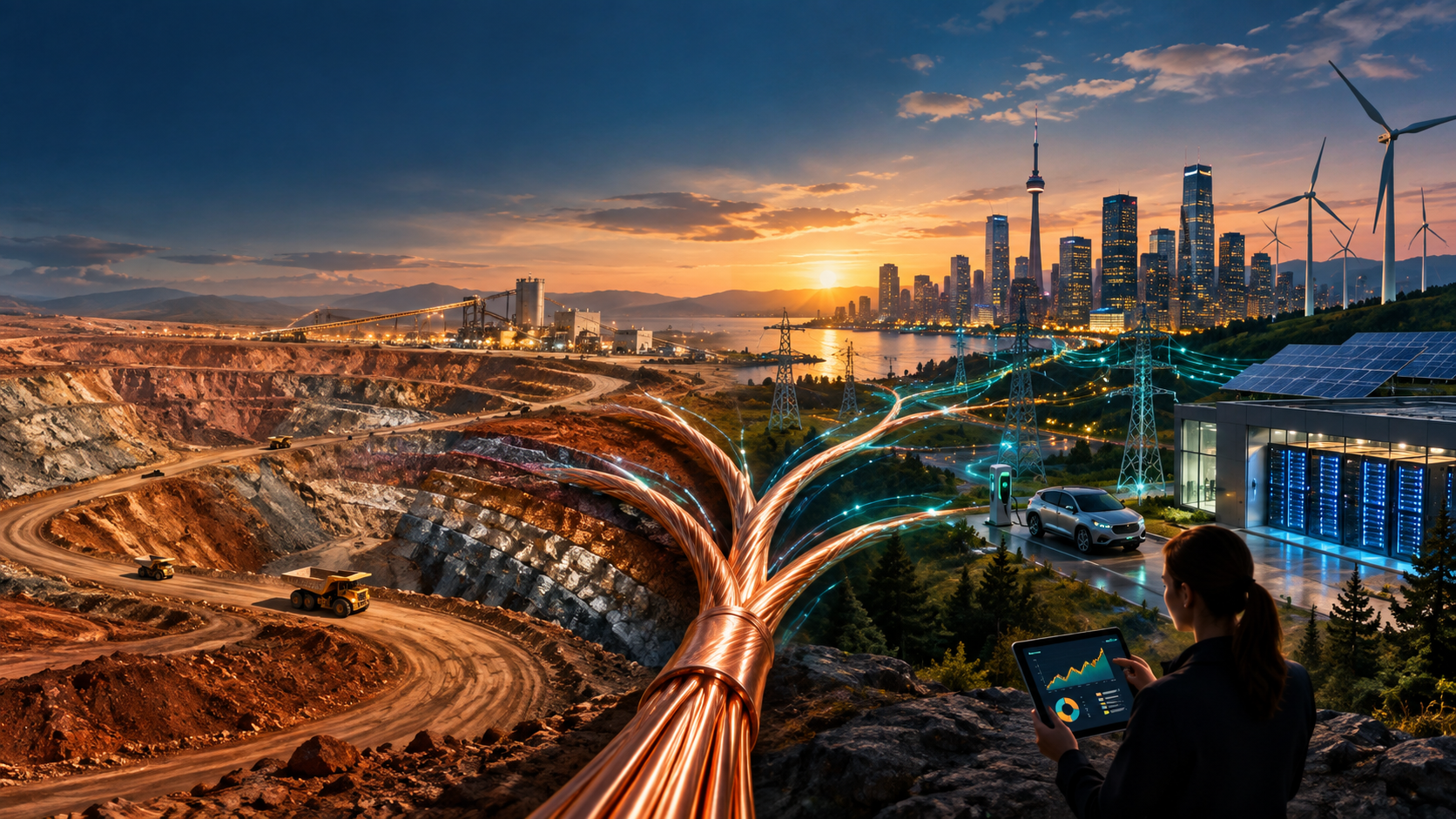
Copper has become one of the most strategically important industrial metals in the global economy. It is essential to electrical wiring, power transmission, electric vehicles, renewable-energy systems, buildings, motors, appliances, telecommunications, defence equipment, data centres, and industrial machinery.
For decades, copper was often treated as a simple economic barometer. When factories expanded, homes were built, and infrastructure spending accelerated, copper demand tended to rise. When economies slowed, copper prices often weakened. That relationship still matters, which is why copper is sometimes called “Dr. Copper.”
But the market is changing.
Copper is no longer only tied to traditional construction and manufacturing. It is increasingly tied to electrification: the shift toward electric vehicles, power grids, renewable generation, battery storage, artificial intelligence, data centres, and energy security. These forces may support demand over many years. At the same time, supply is becoming harder, slower, and more expensive to expand.
For retail investors, this creates an important opportunity—but also a major trap. A positive long-term copper outlook does not mean copper prices or mining stocks will rise in a straight line. Commodity markets are volatile, politically sensitive, cyclical, and vulnerable to sudden changes in global growth, Chinese demand, mine disruptions, interest rates, exchange rates, and investor sentiment.
The right approach is not to bet everything on a copper shortage. The more durable approach is to understand the supply-and-demand dynamics, invest with diversification, and use disciplined risk management.
Copper Demand: From Construction Metal to Electrification Metal
Copper is valuable because it is an excellent conductor of electricity and heat. It is durable, recyclable, corrosion resistant, and widely used across modern infrastructure.
Historically, the largest sources of copper demand have included:
- Residential and commercial construction
- Electrical wiring and plumbing
- Industrial machinery
- Appliances and electronics
- Telecommunications
- Vehicles and transportation
- Power generation and grid infrastructure
These traditional uses remain important. China, in particular, remains the largest driver of copper consumption because of its role in construction, manufacturing, electrical equipment, infrastructure, and global exports.
However, future growth increasingly comes from systems that use more electricity.
The transition from fossil-fuel-based systems to electrified systems requires more cables, transformers, motors, batteries, charging networks, power lines, substations, generators, and electrical equipment. Copper is embedded throughout this transition.
The International Energy Agency expects copper demand to rise strongly over the coming decades as energy systems become more electrified. Copper is projected to experience one of the largest absolute increases in demand among major energy-transition minerals because it is used across so many technologies.
Electric Vehicles Increase Copper Intensity
One of the clearest demand drivers is the growth of electric vehicles.
A conventional gasoline-powered car uses copper in its wiring, alternator, electronics, sensors, starter motor, and smaller electrical systems. An electric vehicle requires much more copper because it includes high-voltage cables, traction motors, inverters, battery connections, electrical control systems, and charging equipment.
A typical electric vehicle can use roughly 83 kilograms of copper—often several times more than a conventional internal-combustion vehicle. The exact figure varies depending on the vehicle’s size, battery capacity, drivetrain design, and whether it is a hybrid, plug-in hybrid, or fully battery-electric vehicle. (spglobal)
The copper story does not end with the vehicle.
Electric-vehicle adoption also requires:
- Home-charging systems
- Public charging stations
- Fast-charging networks
- Local electrical-distribution upgrades
- Transformers and substations
- Power generation and transmission infrastructure
A country can add millions of electric vehicles, but if its local distribution grid cannot handle charging demand, the transition slows. This creates a second layer of copper demand: not only copper in the vehicle, but copper in the electricity infrastructure that makes the vehicle practical.
S&P Global projects that EV-related copper demand could rise from approximately 2.6 million tonnes in 2025 to around 6.3 million tonnes by 2040. (spglobal)
Data Centres and Artificial Intelligence Add a New Source of Demand
Data centres are another growing source of copper demand.
Traditional data centres already require large amounts of wiring, power distribution equipment, switchgear, transformers, cooling systems, backup generators, electrical busbars, and network infrastructure. AI data centres are especially power intensive because they rely on dense clusters of advanced computing chips.
AI training, large-scale inference, cloud computing, automation, robotics, digital services, and high-performance computing all require more electricity. More electricity requires more infrastructure.
Copper is needed inside data centres, but the larger copper requirement may be outside the data-centre building. A large facility may require new transmission capacity, substations, transformers, local distribution upgrades, backup systems, new generation capacity, and grid connections.
The International Energy Agency expects data-centre electricity consumption to increase sharply by 2030. This expansion is not only a technology story; it is an electricity and grid-infrastructure story.tradingkey
S&P Global estimates that global copper demand related to data centres could rise from about 1.1 million tonnes in 2025 to 2.5 million tonnes in 2040. It also estimates that AI-related facilities could account for approximately 58% of data-centre copper demand by 2030.
For investors, this is important because the market may underestimate how much copper is required not only for AI chips and server racks, but also for the electrical systems that power the entire digital economy.
The Grid Is the Largest Long-Term Copper Theme
Electric vehicles and data centres capture headlines, but electricity grids may be the most important long-term driver of copper demand.
Power systems must evolve to handle:
- Growth in electricity consumption
- Renewable-energy generation
- Battery-storage systems
- EV charging
- Industrial electrification
- Data-centre demand
- Distributed energy resources
- Extreme-weather resilience
- National energy-security goals
A power grid requires copper in cables, transmission lines, substations, transformers, circuit breakers, switchgear, motors, connectors, control systems, and electrical equipment.
Renewable-energy projects are copper intensive because wind and solar generation must be connected to the grid, often over long distances. Wind farms, solar facilities, battery systems, and transmission lines all require significant electrical infrastructure.
The result is a powerful long-term theme: nearly every modern investment in electricity generation, transmission, storage, transportation, manufacturing, and digital infrastructure requires copper.
The Near-Term Copper Market Is More Complicated
Long-term demand may be strong, but the near-term market is not guaranteed to be tight.
The International Copper Study Group expects the refined-copper market to show a modest surplus in 2026 and 2027. It projected a refined-copper surplus of about 96,000 tonnes in 2026 and approximately 377,000 tonnes in 2027.
This is an important reminder for investors. A commodity can have a bullish long-term narrative while still experiencing price declines in the short term.
Short-term copper prices are affected by:
- Chinese property activity
- Global manufacturing conditions
- Interest rates
- U.S. dollar strength
- Global recession risk
- Exchange inventories
- Scrap-metal availability
- Mining disruptions
- Smelter activity
- Trade restrictions
- Investor speculation
If China’s construction sector weakens, global manufacturing slows, or the U.S. dollar strengthens, copper prices can decline even if electric vehicles and data centres are expanding.
The market is therefore best understood through two lenses.
In the short term, copper behaves like a cyclical industrial commodity.
In the long term, copper increasingly behaves like strategic infrastructure for electrification.
Both views can be true at the same time.
Copper Supply: The Problem Is Not Geology Alone
The world has significant copper resources, but resources are not the same as economically producible supply.
A copper deposit must be discovered, permitted, financed, built, supplied with water and energy, connected to infrastructure, staffed, processed, transported, and accepted by local communities. This process can take more than a decade.
The central supply challenge is that copper mines are becoming harder to build and operate.
Several factors are driving this challenge:
- Declining ore grades
- Long permitting timelines
- Water scarcity
- Higher capital costs
- Community opposition
- Political and tax uncertainty
- Skilled-labour shortages
- Infrastructure constraints
- Mine accidents and operational disruptions
- Concentration of supply in a few countries and mines
The IEA reports that average copper ore grades in Chile have declined by about 30% over the past 15 years. Lower grades mean miners must move and process more rock to produce the same amount of copper. That raises energy use, water consumption, waste volumes, capital requirements, and operating costs. (iea)
This matters because Chile is the world’s largest copper producer. When the quality of ore declines at giant mines such as Escondida, El Teniente, Collahuasi, Chuquicamata, and other operations, global supply growth becomes more difficult.
Chile, Peru, DRC, and the Concentration of Supply
Copper supply is concentrated in a small number of countries.
Chile is the world’s largest copper producer, accounting for about 23% of global mine supply. The Democratic Republic of the Congo has become a major growth source, while Peru remains another critical global producer. Together, Chile, the DRC, and Peru account for roughly half of the world’s copper mine production.
This concentration creates geopolitical and operational risks.
Chile faces declining ore grades, water stress, labour negotiations, environmental permitting, royalties, taxes, and the need for expensive desalination infrastructure.
Peru has enormous copper resources and world-class mines, but production can be affected by community protests, road blockades, political instability, and disputes over land, water, and local benefits.
The DRC has some of the world’s highest-grade copper deposits and is crucial for future supply growth. However, investors must account for infrastructure challenges, power shortages, governance risk, regulatory uncertainty, logistics limitations, and political risk.
Indonesia also matters because Grasberg is one of the world’s largest copper-gold mines. A disruption at Grasberg can have a disproportionate impact on global supply because so much national output depends on a single major asset.
This is why copper is strategically important: the global market depends not only on demand growth, but on the uninterrupted production of a small number of very large mines.
Sulphuric Acid: A Hidden Copper Supply Risk
One of the most overlooked risks in copper mining is access to sulphuric acid.
Many copper mines use heap leaching and SX-EW processing, especially mines producing oxide copper ores. In this process, sulphuric acid dissolves copper from ore. The copper-bearing solution is then processed to produce cathode copper.
The simplified route is:
Oxide ore → acid leaching → copper solution → solvent extraction → electrowinning → copper cathode
More than 15% of global primary copper supply is produced through SX-EW methods and depends directly on sulphuric acid availability.
The DRC is especially exposed because roughly 45% of its copper production relies on acid leaching. Chile is also vulnerable because a meaningful portion of its copper output depends on acid-intensive leach operations.mining+1
If acid becomes scarce or expensive, mines may reduce leaching activity, prioritize higher-grade ore, delay expansions, or cut output at marginal operations. This illustrates an important lesson for investors: copper supply does not depend only on ore reserves. It also depends on water, power, diesel, chemicals, transportation, labour, and processing capacity.
Why New Copper Mines Take So Long
Copper demand can accelerate relatively quickly. A data centre can be built in a few years. EV production can grow quickly. Governments can announce grid investment plans within a budget cycle.
Copper supply does not respond as fast.
A large new copper mine may take 10 to 20 years from discovery to commercial production. Before construction begins, developers may need to complete exploration, engineering studies, environmental assessments, water planning, community consultation, financing, tax agreements, power arrangements, infrastructure plans, and permitting.
Then comes the difficult part: construction and ramp-up.
Many mines are built in remote regions that require roads, power lines, worker camps, water pipelines, ports, rail links, or concentrate transport systems. Cost overruns, permitting delays, labour shortages, equipment shortages, social opposition, and financing problems can delay a project even after a company has committed billions of dollars.
This time mismatch is central to the long-term copper thesis. Demand can grow faster than supply because mine development is slow, capital intensive, politically exposed, and technically complex.
How Retail Investors Can Participate
Retail investors have several ways to gain exposure to copper. The right method depends on risk tolerance, time horizon, knowledge, account type, and willingness to research individual companies.
The most important rule is simple: treat copper as a satellite investment, not the foundation of a retirement plan.
A diversified portfolio of broad-market equity ETFs should generally remain the core. Copper can be added as a small thematic allocation for investors who believe in electrification, constrained mine supply, and long-term infrastructure spending.
A reasonable illustrative allocation for many growth-oriented investors may be between 3% and 8% of total investable assets. The appropriate allocation depends on an investor’s financial goals, emergency savings, debt levels, employment stability, retirement timeline, and ability to tolerate large drawdowns.
Copper miners can fall 40%, 50%, or more during commodity downturns. Investors should assume that level of volatility is possible before investing.
Option One: Copper-Mining ETFs
For many Canadian investors, a copper-mining ETF is the simplest way to gain diversified exposure.
The Global X Copper Producers Index ETF, trading under ticker COPP on the Toronto Stock Exchange, gives investors exposure to global copper producers through Canadian dollars. It is designed to hold companies active in copper mining and production. Its holdings include companies such as First Quantum, Freeport-McMoRan, Southern Copper, Teck Resources, Ivanhoe Mines, Lundin Mining, Hudbay Minerals, Capstone Copper, BHP, and Rio Tinto.globalx
The advantage of an ETF is diversification. Instead of relying on a single mine, one management team, or one country, investors own a basket of copper producers.
A U.S.-listed alternative is the Global X Copper Miners ETF, ticker COPX. It provides a broad global portfolio of copper miners and reported a 0.65% net expense ratio.globalxetfs+1
For investors who prefer income, the Global X Copper Producer Equity Covered Call ETF, ticker CPCC, uses a covered-call strategy on copper-producer equities. This can generate cash distributions, but it may reduce upside in a strong copper-mining rally. (globalx)
The key distinction is important:
- A mining ETF gives exposure to mining companies.
- A futures-based product seeks more direct exposure to copper prices but may experience futures-roll costs and tracking differences.
- A covered-call fund emphasizes income but may sacrifice some capital appreciation.
For long-term investors, diversified mining ETFs are often easier to understand than futures-based products.
Option Two: Large Copper Producers
Investors who want more direct exposure can research large established copper companies.
Examples include:
- Freeport-McMoRan
- BHP Group
- Southern Copper
- Antofagasta
- Lundin Mining
- Teck Resources
- Glencore
- Rio Tinto
These companies can benefit from higher copper prices because their revenues rise as copper prices increase. If their operating costs remain relatively stable, higher copper prices can lead to disproportionately higher cash flow and profits.
However, miners are not the same as copper.
A mining company is exposed to the copper price, but also to:
- Mine grades
- Labour costs
- Energy costs
- Water availability
- Political risk
- Taxes and royalties
- Community relations
- Currency movements
- Safety issues
- Debt levels
- Capital spending
- Management decisions
- Acquisition risk
- Smelter access
- Transportation costs
BHP is generally a lower-risk diversified mining company because it has major copper assets but also produces iron ore, coal, potash, and other commodities. Freeport-McMoRan is one of the more direct large-cap copper exposures, with major mines in the United States, Peru, and Indonesia. Southern Copper offers long-life copper assets in Mexico and Peru but carries geographic concentration.
Option Three: Growth and High-Risk Copper Companies
Some investors may want exposure to higher-growth copper companies such as Ivanhoe Mines, Lundin Mining, Capstone Copper, Hudbay Minerals, or First Quantum Minerals.
These companies may offer more upside if they successfully expand production, develop new mines, improve operating performance, or benefit from higher copper prices.
But they also carry higher risk.
Ivanhoe Mines, for example, has major long-term potential through the Kamoa-Kakula copper complex in the DRC. The company guided for 380,000 to 420,000 tonnes of production in 2026 and 500,000 to 540,000 tonnes in 2027 on a 100%-project basis, subject to its recovery and expansion plans. (ivanhoemines)
That growth potential comes with DRC country risk, single-asset concentration, operating risk, logistics exposure, and project execution risk.
First Quantum Minerals may offer recovery potential, but the closure of Cobre Panamá demonstrates why investors must assess jurisdiction and political risk carefully. A large resource in the ground has limited value if a mine cannot legally operate.
These types of stocks should generally represent only a small portion of an investor’s copper allocation.
A Practical Retail-Investor Framework
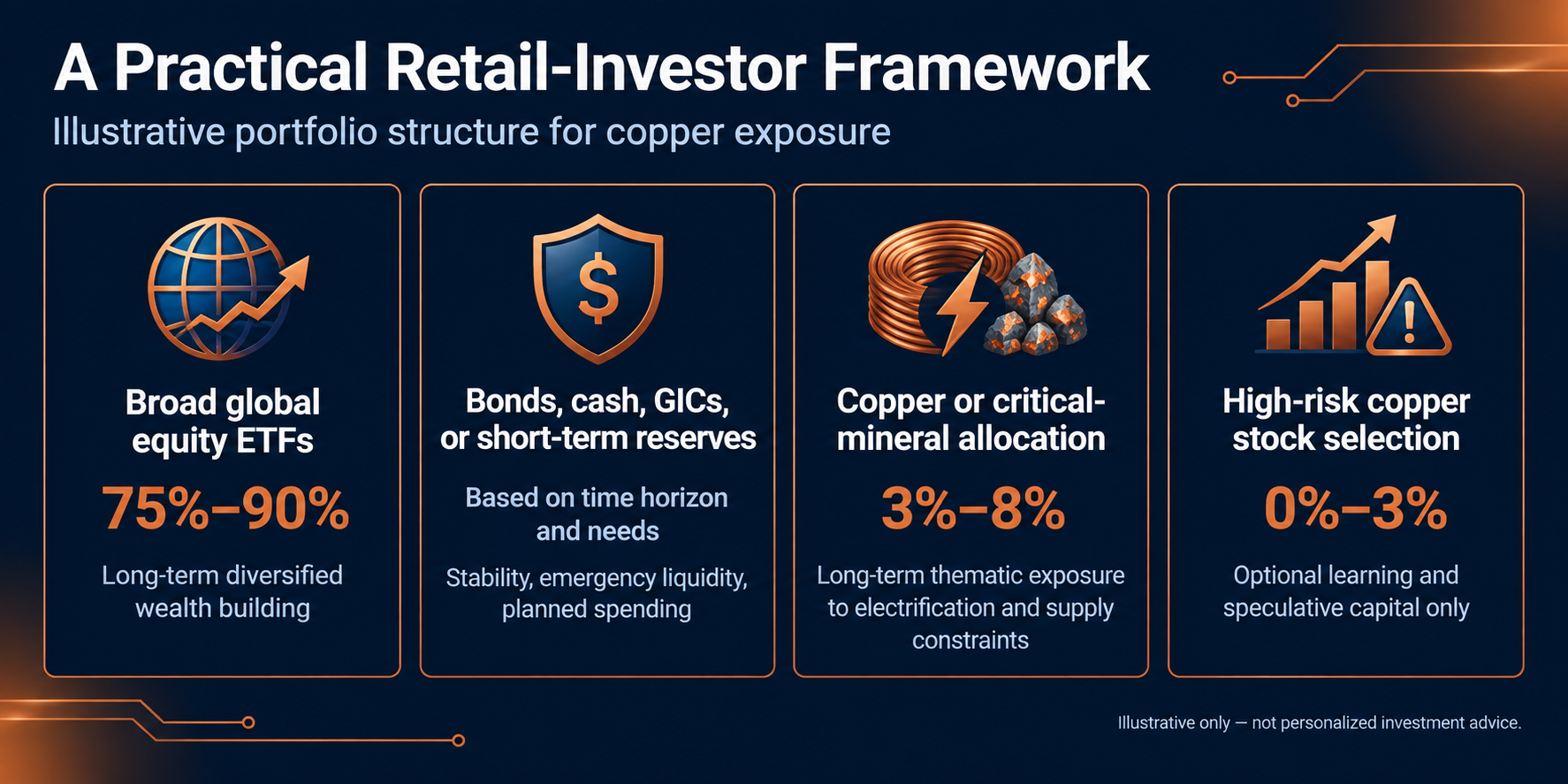
This is only an illustration. The point is to create a structure that allows participation without turning a retirement portfolio into a single-commodity bet.
Risk Management Strategies for Copper Investors
The best investment thesis can still lose money if risk is poorly managed. Copper investors should use a written plan.
Use position limits
Set a maximum amount that can be allocated to copper, mining, or critical minerals. A position limit prevents enthusiasm from turning into overconcentration.
For example, an investor might decide that copper-related investments cannot exceed 5% of total assets. If the position rises to 8% after a rally, the investor trims it back toward the target.
This forces disciplined profit-taking without needing to predict the exact market peak.
Dollar-cost average instead of chasing
Copper prices can rise quickly after mine disruptions, Chinese stimulus announcements, or bullish supply forecasts. Buying after a large rally can create regret if the market pulls back.
A better strategy is often to invest fixed amounts monthly or quarterly over six to twelve months.
Dollar-cost averaging does not guarantee a profit, but it reduces the risk of investing the entire allocation at one unusually high price.
Diversify across companies and countries
Avoid concentrating all copper exposure in one company, mine, or country.
A portfolio heavily exposed to Chile faces water, grade, tax, and permitting risk. A portfolio concentrated in the DRC faces geopolitical, transport, and governance risk. A portfolio dependent on one mine can be devastated by an accident, strike, tailings event, underground failure, or permit suspension.
An ETF can help diversify these risks. Investors who select individual stocks should consider holding companies with operations across multiple regions.
Watch balance sheets
Mining is capital intensive. Companies with high debt are more vulnerable if copper prices decline, operating costs rise, or projects face delays.
Before investing in an individual miner, examine:
- Net debt and debt maturity schedule
- Cash balance
- Operating cash flow
- Free cash flow
- Capital-expenditure commitments
- Dividend policy
- Reserve life
- Production guidance
- Cost guidance
- Sensitivity to copper prices
A low-cost producer with a strong balance sheet can survive a downturn more easily than a highly indebted company that needs a high copper price simply to remain financially stable.
Separate investing from speculation
Copper is a legitimate long-term theme, but junior exploration companies, options, leveraged ETFs, and futures contracts are speculative instruments.
A useful rule is to keep long-term investments and high-risk trading separate.
Long-term investments should be diversified, sized conservatively, and held according to a written thesis. Speculative positions should be limited to money that can be lost without affecting housing, debt repayment, emergency savings, education goals, or retirement contributions.
Avoid using margin to invest in volatile mining shares. A correct long-term thesis can still fail if leverage forces a sale during a drawdown.
Rebalance annually
Rebalancing is one of the simplest risk-management tools.
If copper miners double and become an oversized share of the portfolio, sell enough to restore the target allocation. If copper falls sharply but the long-term thesis remains intact, adding gradually may restore the position to its target.
Rebalancing encourages investors to trim winners and add selectively to lagging holdings without relying on emotion.
Monitor the right indicators
Investors do not need to trade every headline, but they should track the indicators that matter most:
- Chinese manufacturing and property activity
- Global industrial production
- Copper inventories on major exchanges
- Treatment and refining charges
- Chilean and Peruvian mine performance
- DRC and Zambian infrastructure and policy developments
- Major mine disruptions
- Copper-miner cost inflation
- New mine-project approvals and delays
- Global scrap collection and recycling activity
- U.S. dollar movements and interest rates
The goal is not to forecast every price move. The goal is to know whether the original investment thesis is improving, weakening, or becoming too risky.
Canadian Account Considerations
For Canadian investors, a TFSA can be attractive for long-term equity investments because qualifying gains and withdrawals are generally tax-free. An RRSP can also support long-term investing, especially when an employer contribution or match is available.
However, investors should avoid frequent trading inside registered accounts. A long-term investment approach is easier to support than a high-frequency trading pattern, particularly in a TFSA.
Before buying a copper ETF or stock, check:
- Whether it trades in Canadian or U.S. dollars
- Currency-conversion costs
- Management fees
- Bid–ask spreads
- Assets under management
- Fund holdings and concentration
- Whether it owns miners, futures, or both
- Distribution policy
- Account eligibility at your brokerage
- Whether the position fits your broader retirement and tax strategy
For many Canadians, a TSX-listed ETF such as COPP can simplify purchases because it trades in Canadian dollars. Investors who already hold U.S. dollars may consider U.S.-listed products such as COPX, but should understand currency exposure and tax considerations.
The Bottom Line
Copper is entering a new phase.
Traditional demand from construction, manufacturing, appliances, and infrastructure remains important. But new demand from electric vehicles, charging networks, power grids, renewable energy, battery storage, data centres, artificial intelligence, and electrified industry is increasing the metal’s strategic importance.
At the same time, supply growth is constrained by declining ore grades, long permitting timelines, water shortages, sulphuric-acid availability, capital costs, geopolitical risk, infrastructure limits, and the concentration of production in a handful of countries and mines.
This combination supports a strong long-term investment case—but it does not eliminate the risks of commodity cycles.
For retail investors, the most responsible approach is to keep a diversified portfolio, use copper as a modest satellite allocation, build exposure gradually, favour strong balance sheets and diversified assets, avoid excessive leverage, and rebalance consistently.
The future may be electric, digital, and infrastructure-heavy. Copper is likely to remain at the centre of that transformation. But successful investors will not rely only on a bullish story. They will pair opportunity with discipline, diversification, and risk management.