
From Oil Rigs to AI Chips: Five Decades of Market Leadership and Why Every Crown Eventually Slips
Market leadership never stays still. Over the past fifty years, dominance has rotated from energy in the 1970s, to consumer staples in the 1980s, technology in the 1990s, commodities in the 2000s, and back to technology through the 2010s and today's AI-and-semiconductor boom. Each "unstoppable" leader eventually gave ground to the next theme, yet rotation rarely meant collapse. This article traces that history, examines the Magnificent Seven's extraordinary decade, and asks whether AI and chip stocks are truly losing their grip. The honest answer is nuanced: real warning signs exist, but so does credible evidence we're still early in AI's economic story.
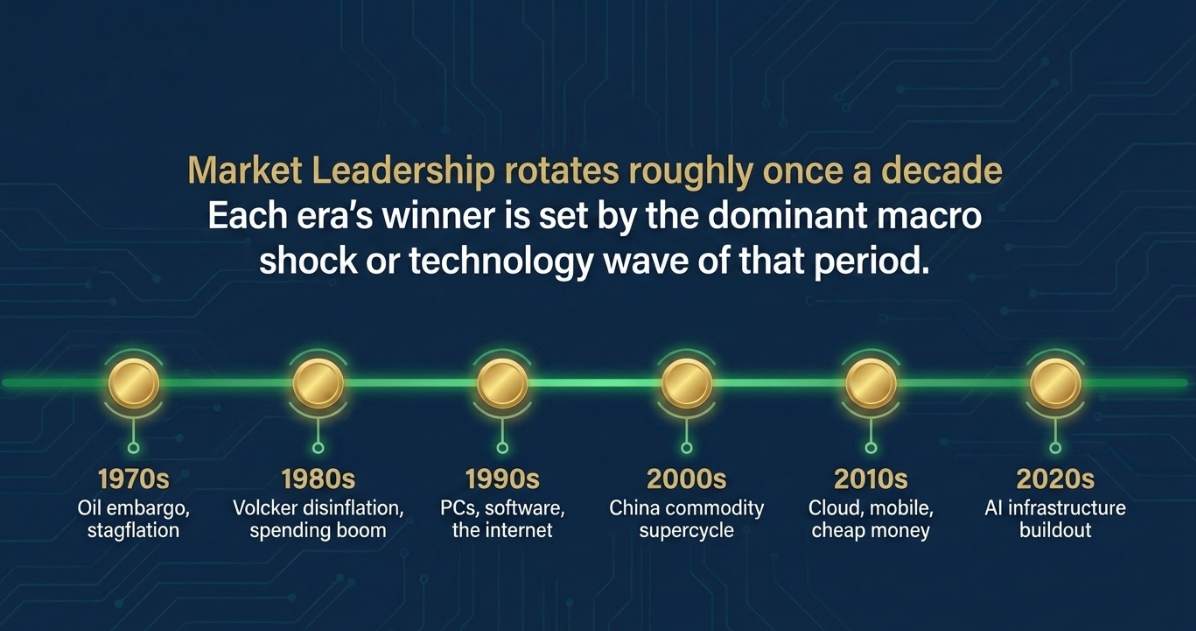
If you've spent any time around financial markets, you've probably noticed a pattern: there is always a "hot" sector. Right now, it's artificial intelligence and semiconductors. Ten years ago, it was cloud computing and mobile technology. Before that, it was commodities and emerging-market growth. Go back far enough, and you'll find eras dominated by energy, consumer staples, and dot-com internet stocks. Each of these leaders felt unstoppable at the time. Each one eventually gave way to something new.
This is the central lesson of market history, and it's one every investor; especially those building long-term wealth rather than chasing headlines, needs to internalize. Sector leadership rotates. It always has. But rotation doesn't always mean a leader is finished; sometimes it just means the easy phase of a theme is ending while the harder, more selective phase begins. Understanding why leadership rotates, what's driving the current AI-led cycle, and critically, whether AI and semiconductors are genuinely losing their grip or simply maturing into their next phase, is the focus of this article.
The Fifty-Year Rotation: A Decade-by-Decade Walk Through Market History
The 1970s: Energy Takes the Crown
The 1970s were defined by two seismic shocks to the global oil market: the 1973 Arab oil embargo and the 1979 Iranian Revolution. Both events sent crude prices soaring and triggered a decade of stagflation that crushed most of the stock market. Yet energy stocks thrived. From 1971 to 1981, the sector delivered real gains of roughly 73%, even as inflation and stagnant growth battered nearly everything else.
The names that defined this era are still household brands today: ExxonMobil, Chevron, and Schlumberger. These companies benefited directly from surging oil prices and the world's sudden, urgent need for domestic energy security. Investors who recognized the shift early and tilted into energy were rewarded handsomely while the broader market treaded water.
The 1980s: Consumer Staples and the Post-Volcker Boom
By the early 1980s, Federal Reserve Chair Paul Volcker had waged a brutal war on inflation through aggressive interest rate hikes. It worked. Once inflation was tamed, consumer confidence rebounded, and a new culture of consumerism took hold across America. Spending replaced saving as the dominant household behavior, and consumer staples stocks became the era's biggest winners.
Philip Morris, now known as Altria, is the poster child of this period. It was actually the top-performing stock in the entire S&P 500 from 1957 through 2003, turning a $1,000 investment into more than $4.6 million over that stretch. Coca-Cola and Procter & Gamble rounded out the staples leadership, riding the same wave of rising consumer spending and brand loyalty that made these companies cash-generating machines for decades.
The 1990s: The Rise of Information Technology
The 1990s belong to technology, full stop. Cheap capital, the rise of personal computing, and the dawn of the commercial internet fueled one of the most explosive bull runs in stock market history. Dell Computer is the standout example — the stock rose more than 91,000% between 1989 and 1999, a return so extreme it's hard to comprehend even in hindsight.
Microsoft and Intel were the other giants of this era, essentially building the operating systems and processors that powered the entire personal computing revolution. Of course, the decade ended in the dot-com bust, a painful reminder that even legitimate technological revolutions can outrun their fundamentals and correct violently. Still, for those who held through the volatility, 1990s tech leadership set the template for the mega-cap technology dominance we see today, and it's worth remembering that the internet didn't disappear after the crash, it simply separated real businesses from speculative ones.
The 2000s: Energy and Materials Ride the China Supercycle
The 2000s were a rough decade for the broad stock market. Bookended by the dot-com crash at the start and the Global Financial Crisis at the end, the S&P 500 was essentially flat to negative for the entire ten-year stretch. Yet one sector quietly delivered strong returns throughout: energy and materials.
China's entry into the World Trade Organization in 2001, combined with roughly 10% annual GDP growth throughout the decade, created enormous demand for commodities, oil, and industrial materials. The energy sector alone returned 144% over the decade an annualized 14.4% — even as most other sectors went nowhere. ExxonMobil and Chevron again featured prominently, joined this time by Freeport-McMoRan, a major copper and materials producer that benefited directly from China's infrastructure boom.
The 2010s: Technology and Semiconductors Reassert Dominance
With interest rates pinned near zero for most of the decade, capital flowed heavily toward large-cap technology companies with strong balance sheets and reliable free cash flow. Semiconductors, the commodity-like chips that power every modern device, became an increasingly important sub-theme within tech's broader outperformance.
Apple, Microsoft, and NVIDIA were the standout names of this period. Apple's iPhone ecosystem matured into one of the most profitable business models in corporate history. Microsoft successfully pivoted to cloud computing under new leadership. And NVIDIA, still primarily known as a gaming-graphics company at the start of the decade, was quietly building the parallel-processing architecture that would later become essential to artificial intelligence.
The 2020s: AI and Semiconductors Take Over
Which brings us to today. This decade's defining theme is the artificial intelligence infrastructure buildout, and its dominance has been staggering. Nine of the ten best-performing S&P 500 stocks over the past ten years trace their gains directly to AI chips, networking equipment, and data-center demand. NVIDIA's ten-year return sits near an almost unbelievable 24,000%, meaning a $1,000 investment a decade ago would be worth roughly $244,000 today.
Even amid volatility in 2026, semiconductors and energy have remained among the best-performing sectors year-to-date, with Micron up 634% and AMD up 156% over the trailing year at various points. NVIDIA, AMD, and Micron represent the current torchbearers of this theme, much as Dell, Microsoft, and Intel did in the 1990s, and as Apple, Microsoft, and NVIDIA did in the 2010s.
The Common Thread: Every Leadership Cycle Eventually Rotates — But Rotation Isn't the Same as Death
Look at that fifty-year arc again. Energy in the 1970s. Consumer staples in the 1980s. Tech in the 1990s. Commodities in the 2000s. Tech again in the 2010s. AI in the 2020s. Notice that even sectors that led one decade — like energy in the 1970s and again in the 2000s — didn't lead every decade in between, yet energy companies didn't vanish; they simply stopped being the story for a while before returning. This distinction matters. Historically, leadership rotation has meant relative underperformance and a changing of the spotlight, not necessarily the outright collapse of the underlying business or technology. The internet didn't die after 2000; it became infrastructure. Personal computing didn't die after the 1990s; it became a mature, cash-generating industry rather than a hypergrowth one.
This matters enormously for how you think about investing today. The sector or stock crushing the market right now will not lead forever in the same explosive way. But the more useful question isn't simply "will AI stocks lose their grip?" It's "are we watching a genuine technology bubble detached from real-world use, or are we watching an early-stage technology that hasn't even reached its adoption phase yet?" The honest answer, based on the evidence, is probably somewhere in between — and that nuance deserves far more attention than a simple yes-or-no verdict.
The Magnificent Seven: A Case Study in Concentrated Leadership
No discussion of recent market leadership is complete without examining the Magnificent Seven — Apple, Microsoft, Amazon, Alphabet, Meta, NVIDIA, and Tesla. This group has defined market returns for the past decade in a way that arguably eclipses any prior leadership cohort, and the dispersion of returns within the group tells its own story about how dramatically AI reshaped outcomes even among elite companies.
As of early 2026, the ten-year returns within this group ranged enormously. NVIDIA sits at the top with a roughly 24,000% ten-year gain, powered almost entirely by the AI chip boom. Tesla follows with about 3,200% over the decade. Apple returned roughly 1,000%. Alphabet delivered about 787%. Microsoft returned close to 670%. Amazon returned around 660%. And Meta, the relative laggard of the group, still managed close to 505% — a return that would be considered spectacular in almost any other context, yet pales next to NVIDIA's numbers.
Collectively, the group delivered an average annualized return of roughly 38.7% over the past decade, more than three times the S&P 500's annualized return of about 12.8% over the same period. Looked at cumulatively, the Magnificent Seven returned around 698% from 2015 to 2024, compared to roughly 235% for the broader index. They outperformed the S&P 500 in eight of the last ten years. Their dominance intensified sharply after 2020: in 2023 they surged 76% versus 24% for the broader index, contributing 63% of the index's total gains that year, and in 2024 they returned 48% against the index's 23%.
But 2026 has told a more mixed story. Through the first two months of the year, the Magnificent Seven were down roughly 7% collectively, while the broader S&P 500 was essentially flat, and the rest of the index — often called the "S&P 493" — was actually up about 4%. By mid-2026, several members showed flat or negative one-year returns: Amazon down about 1%, Meta down slightly, and Microsoft barely positive. Whether this is the start of a broader rotation away from these names or simply a mid-cycle pause deserves a genuinely balanced look, not a premature verdict either way.
Is AI and Semiconductor Leadership Really Fading? A Skeptically Balanced View
This is where a solid "yes, AI is losing its grip" answer becomes too simplistic. There's real evidence pointing toward increased volatility and rotation in the near term, but there's also compelling evidence that we're still in the early innings of AI's economic story and dismissing that case would be its own kind of overcorrection.
The Case for Caution
Several genuine warning signs have emerged in recent months. On September 14, 2026, AI-linked stocks tumbled worldwide after the CEOs of major AI labs publicly called for slowing the pace of AI development, citing potentially existential risks from the technology. Semiconductor stocks lost over a trillion dollars in value during a single stretch in July 2026, with Intel falling 21% in seven trading days and Micron dropping 13% in a single session, even as companies like TSMC posted record quarterly earnings — a sign that some names had become priced for perfection. Michael Burry disclosed short positions against NVIDIA, Applied Materials, and Tesla, warning that he believes an AI bubble unwind is imminent. And FactSet data shows 2026 earnings growth expectations for the Magnificent Seven have fallen to around 24%, while expectations for the rest of the S&P 500 have risen to roughly 12%, suggesting institutions are quietly reducing concentration even as retail investors keep buying dips.
Adoption data also shows real friction, not just hype. Gartner's own research projects that while task-specific AI agents will jump from under 5% of enterprise applications in 2025 to roughly 40% by the end of 2026, more than 40% of agentic AI projects will be abandoned by 2027 due to runaway costs, unclear return on investment, and governance failures. Separate research from Gartner's CIO survey puts actual production deployment as low as 17%, even though many more organizations are piloting the technology. This gap between ambition and execution is a legitimate reason for skepticism.
The Case for Patience and Optimism
Here's where your instinct is right to push back on a "solid yes" verdict. AI, as a commercially deployed general-purpose technology, is genuinely young compared to previous market-leading innovations. Personal computing and the internet both had multi-decade adoption curves before their economic value was fully realized in productivity and profit. AI arguably only exited its research-and-training-heavy phase in the last two or three years, and mainstream consumers still largely experience it through chatbots rather than through its deeper applications in robotics, drug discovery, logistics, or autonomous systems. Most consumers genuinely don't yet understand the scope of what's coming, which is itself evidence that the adoption curve — and the resulting economic and earnings impact — still has a long runway ahead.
The people building this technology keep saying exactly that. NVIDIA CEO Jensen Huang told the Goldman Sachs Technology Conference in September 2026 that the AI buildout is "still in its early stages," even while acknowledging real supply-chain limits, land shortages, and power constraints that could slow near-term deployment. Huang has repeatedly framed this moment as the start of a new industrial revolution rather than a peak, arguing that AI is already reshoring manufacturing and creating entirely new companies and industries, with $400 billion invested in AI startups in just the past six months.
Elon Musk has made even bolder public predictions throughout 2026 — arguing at Davos that ubiquitous AI and robotics could unleash an economic expansion "beyond all precedent," and telling the G20 in September 2026 that AI will be able to handle essentially all digital work within twelve to eighteen months, with over a billion humanoid robots operating within a decade, each roughly five times as productive as a human worker. Whether or not those specific timelines prove accurate, the underlying claim — that we are still near the beginning of AI's real-world economic impact rather than near the end — is a serious, credible position held by the people with the most visibility into where the technology is heading.
Agentic AI is the clearest evidence of this next stage actually arriving. Enterprise adoption of AI agents has accelerated dramatically: more than four in ten organizations now have agents in production, up from almost none just a year earlier, and 91% of surveyed executives plan to increase agentic AI budgets in 2026. The global agentic AI market has already surpassed $9 billion in 2026, and financial services and technology companies are reporting adoption rates above 85%. This is not a stalled technology; it's a technology in the messy, uneven middle of a genuine adoption wave — some pilots failing, others scaling successfully, exactly as you'd expect from a transformative but still-maturing innovation.
Tesla's robotaxi rollout tells a similar story of real but uneven progress. As of mid-2026, Tesla operates unsupervised, driverless robotaxi service in Austin, Dallas, and Houston, with Phoenix in preparation and additional cities like Miami, Orlando, Tampa, and Las Vegas delayed from original targets. The rollout has been genuinely slower than promised — some cities have launched with just a single vehicle — but the underlying achievement, truly driverless commercial ride service operating on public roads in multiple U.S. cities, is a milestone that didn't exist at all a few years ago. It's a powerful proof point that autonomous systems and AI-driven robotics are transitioning from demonstration to deployment, even if the pace is slower and messier than the most bullish predictions suggested.
The Balanced Verdict
So is AI and semiconductor leadership fading? The fair answer is: partially, unevenly, and probably temporarily in its current form, rather than definitively. The easy, indiscriminate phase where nearly any AI-adjacent stock rallied regardless of fundamentals does appear to be ending, based on the valuation stress, institutional de-risking, and governance concerns showing up in 2026 data. But the deeper structural story — genuine enterprise agentic AI adoption, real (if delayed) autonomous vehicle deployment, humanoid robotics progressing from prototype toward commercial use, and the technology's own architects insisting we're still early — suggests this is a maturing, selective phase of AI leadership rather than the sunset of the theme altogether. History backs this reading too: the dot-com crash didn't end the internet's economic impact; it simply separated the companies with real business models from those riding pure hype. AI in 2026 looks like it may be entering a similar sorting phase rather than a terminal decline.
Where Is the Capital Actually Going?
Importantly, money isn't fleeing equities altogether — it's rotating into specific alternatives, and tracking those flows tells you a lot about where the next leadership cycle might emerge, or which parts of the AI theme are proving durable. Value stocks and small-caps have quietly outperformed this year; Vanguard's Value ETF returned about 18.5% year-to-date through early September 2026, comfortably ahead of the S&P 500's roughly 12.3% over the same stretch. Financials have also drawn attention, with several major bank analysts flagging the sector as having "legs" heading into the second half of 2026. Industrials, energy, and defense names are benefiting from what some strategists call a "bits to atoms" rotation — capital moving from purely digital themes into companies that build physical infrastructure.
Even within technology, the rotation is nuanced rather than a wholesale exit. Retail investors are increasingly shifting away from the core Magnificent Seven names and toward AI infrastructure "picks and shovels" plays — memory chip makers and data-center suppliers — rather than abandoning the AI theme entirely. It's also worth noting that several of these rotations have reversed quickly once strong earnings came through, suggesting this is currently more about heightened volatility and careful stock-picking within AI than a clean, permanent sector exit.
How Retail Investors Should Think About Positioning
Given this more nuanced picture, how should an everyday investor — someone building wealth steadily rather than day-trading headlines — actually respond? A few practical, historically grounded principles apply.
First, understand your actual concentration risk. Many popular index funds and workplace retirement accounts are now heavily weighted toward the Magnificent Seven and AI-adjacent names, simply because these stocks have grown to represent such a large share of major indexes. You may be far more exposed to AI-sector volatility than you realize, even if you've never directly purchased NVIDIA or any other individual AI stock.
Second, consider modest tilts toward value and small-cap strategies without abandoning your AI exposure entirely. Adding measured exposure to value or small-cap funds can help you participate in market broadening while still holding a stake in a technology that credible voices — including the people literally building it — insist is still early in its economic impact.
Third, don't confuse short-term rotation signals with a verdict on the technology's long-term trajectory. The evidence suggests discriminating between winners and losers within AI matters more right now than making a binary bet either for or against the entire theme. Companies with genuine agentic AI production deployments, real robotaxi revenue, or durable data-center demand look different from companies riding pure narrative momentum.
Fourth, size any tilt or rotation at a level you can genuinely hold through volatility, in either direction. If AI turns out to be as early-stage as Huang and Musk suggest, you don't want to have exited entirely during a temporary pullback. If it turns out current valuations were overextended, you don't want to be dangerously concentrated when the correction lands. A measured, diversified position lets you benefit from either outcome without betting your entire financial future on being right about the exact timing.
Fifth, pay close attention to valuation discipline rather than pure momentum or hype in either direction. The pattern of record earnings being met with selling, as happened with TSMC and Samsung in mid-2026, illustrates that even genuinely strong fundamentals don't protect an overvalued stock from repricing. At the same time, real adoption data — agentic AI budgets rising, robotaxi service expanding to new cities, humanoid robots moving from labs toward pilot deployments — shows this isn't pure hype either. This is precisely the kind of balanced, evidence-based thinking that separates investors who compound wealth steadily over decades from those who overreact to any single headline.
Finally, use rebalancing as a disciplined tool rather than an emotional reaction to either bullish predictions or bearish warnings. If years of AI and technology outperformance have pushed your portfolio's tech allocation well beyond your original target, trimming back toward that target is a systematic way to lock in gains without betting your entire financial future on one theme continuing at its most explosive pace indefinitely — while still keeping meaningful exposure in case the early-stage thesis proves correct.
The Honest Takeaway
Nobody, no matter how sophisticated, can reliably call the exact top of a market cycle or the precise moment leadership changes hands. What history does offer, across fifty years and six distinct leadership cycles, is a remarkably consistent pattern: today's dominant sector eventually rotates out of the spotlight — but rotation and death are not the same thing. Energy gave way to consumer staples, then returned decades later. The internet crashed in 2000 and then went on to reshape the entire global economy over the following two decades.
AI and semiconductors in 2026 show real signs of near-term rotation stress: stretched valuations, institutional caution, project cancellations, and a genuine debate about whether the infrastructure spending is outrunning near-term returns. But they also show real signs of being early in a much longer adoption curve: agentic AI moving from pilots to production, robotaxis operating driverless on public roads in multiple cities, humanoid robotics advancing from demonstration toward commercial pilots, and the technology's own builders — people with more visibility into the pipeline than any outside analyst — consistently arguing that the most transformative applications are still ahead, not behind.
For investors building long-term wealth, the most honest position isn't a confident yes or no on whether AI leadership is ending. It's holding both possibilities seriously: staying diversified enough to withstand a genuine correction if current valuations prove too aggressive, while staying invested enough to participate if the early-stage thesis from Huang, Musk, and the enterprise adoption data proves correct. That kind of balanced humility, rather than a strong prediction in either direction, is what fifty years of rotating market leadership should teach every investor to respect.