
Why Patience and Resilience Are the True Engines of Growth Investing
When new investors enter the stock market, they often expect immediate results. They want the thrill of an overnight success, treating the market like a casino where the right "hot tip" or high-momentum stock will instantly change their lives. But if you study the history of the world's most successful businesses, you will quickly learn a different truth: generational wealth is not built on luck or rapid trading. It is built on profound patience and unbreakable resilience.

By Gabriel Gachange, Founder of Thrive Nation Finance
When new investors enter the stock market, they often expect immediate results. They want the thrill of an overnight success, treating the market like a casino where the right "hot tip" or high-momentum stock will instantly change their lives. But if you study the history of the world's most successful businesses, you will quickly learn a different truth: generational wealth is not built on luck or rapid trading. It is built on profound patience and unbreakable resilience.
True growth investing is a grueling test of endurance. It means having the discipline to hold onto fundamentally sound companies through market crashes, economic uncertainty, and the long years when a business is intentionally losing money to capture market share. At Thrive Nation Finance, we teach that market drawdowns and periods of extreme volatility are not reasons to panic—they are the proving grounds where financial giants are forged.
Whether you are funding your TFSA, maximizing your RRSP, or managing a taxable account, you must develop the psychological resilience to separate temporary market noise from long-term business execution. In this guide, we are going to explore why the world’s biggest companies (the "Magnificent Seven") required decades of patient capital to achieve their dominance, how to structure a resilient portfolio that weathers market storms, and how to spot the red flags that separate a temporary setback from a permanently failing business.
Rome Wasn’t Built in a Day: The Magnificent Seven Timeline
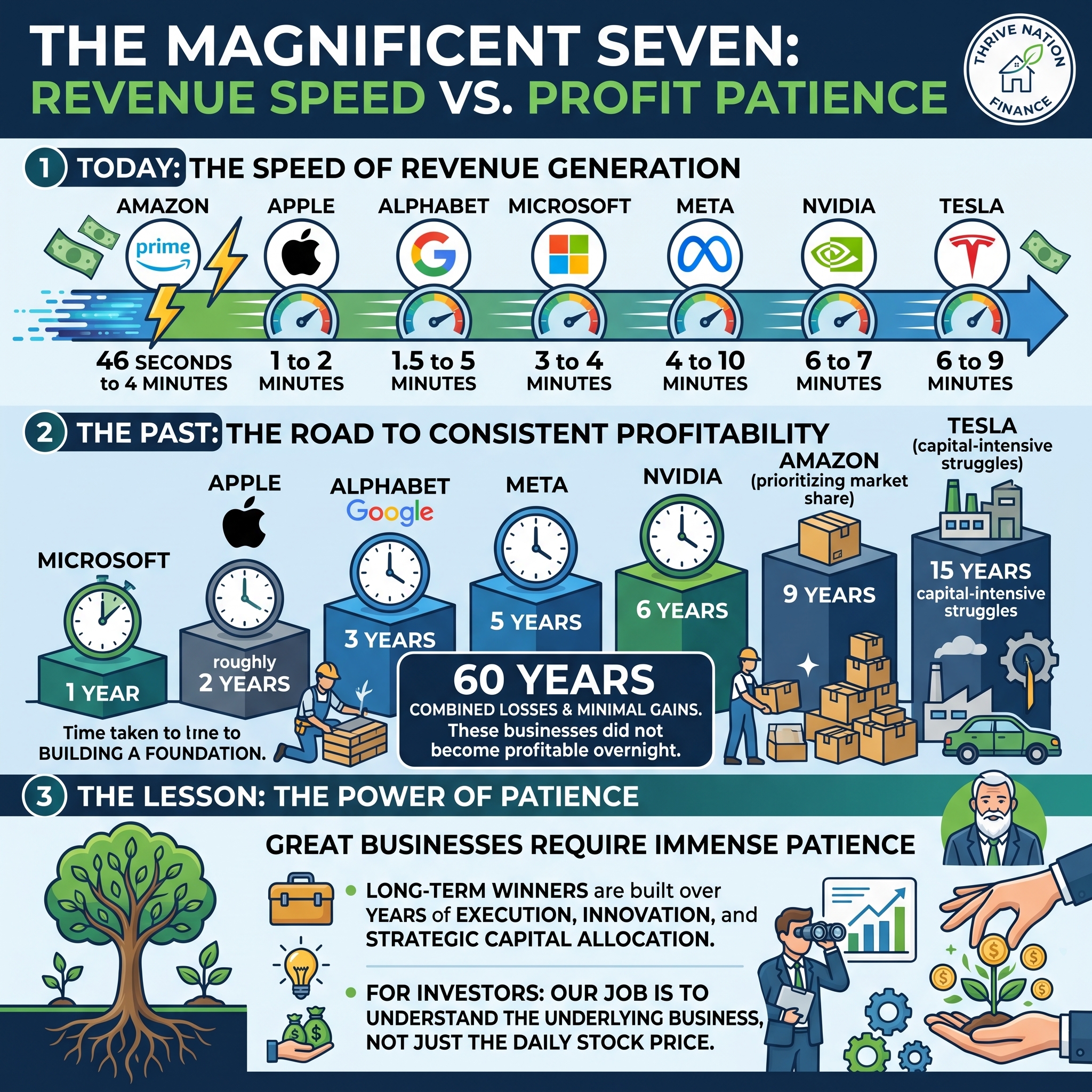
Today, companies like Apple, Microsoft, and Amazon are financial juggernauts. They operate at a scale that is almost impossible to comprehend. Consider how quickly these companies currently generate $1 million in revenue: Amazon: 46 seconds to 4 minutes Apple: 1 to 2 minutes Alphabet (Google): 1.5 to 5 minutes Microsoft: 3 to 4 minutes Meta: 4 to 10 minutes Nvidia: 6 to 7 minutes Tesla: 6 to 9 minutes
These numbers are staggering. But it is crucial for retail investors to remember that these companies did not become profitable overnight. In fact, if you tally the years it took for the "Magnificent Seven" to reach consistent profitability, it amounts to roughly 60 years of combined losses and minimal gains.
Microsoft became profitable in about 1 year, and Apple took roughly 2 years. Alphabet needed 3 years, Meta took 5, and Nvidia required 6 years. Amazon famously prioritized market share over short-term profits, taking 9 years to turn a consistent profit, while Tesla endured 15 years of capital-intensive struggles before reaching profitability.
The lesson here is profound: Great businesses require immense patience. Long-term winners are built over years of execution, innovation, and strategic capital allocation. As investors, our job is not just to watch the daily stock price, but to understand the underlying business.
How Growth Companies Fund Years of Losses
If a company like Amazon or Tesla lost money for a decade or more, how did they survive? How do growth-focused companies fund their operations while they bleed cash? The answer lies in strategic financing. These companies intentionally operate at a loss to create a "moat"—a competitive advantage that protects them from rivals. They use external funding to rapidly capture market share, build technological infrastructure, or hook customers into their ecosystem before competitors can catch up. Here is how the funding lifecycle typically works:
1. Venture Capital (Early Stage)
In the beginning, when a startup has a disruptive idea but unproven cash flows, they rely on Venture Capital (VC). VC firms invest in high-risk, high-reward startups, knowing that while most will fail, a few massive winners will cover the losses. VC money is disbursed in stages (Seed, Series A, Series B) as the company hits specific growth milestones. In exchange for this cash, founders give up equity in the company.
2. Private Equity and Growth Equity (Mid-Stage)
As a company matures and proves its business model, even if it is still unprofitable, it may attract Growth Equity. While traditional Private Equity usually buys mature, cash-flowing companies to optimize them, growth equity injects capital specifically to fund further expansion, product development, or market penetration prior to an IPO.
3. Public Markets and Stock Issuance (Late Stage)
If a company goes public (IPO) before it is profitable, it funds its ongoing losses by selling shares on the open market. Investors are willing to tolerate current losses if the company is growing revenues rapidly and capturing significant market share. Because the market values the future potential of the company, its stock price remains high, allowing the company to issue new shares to raise billions in cash without heavily diluting existing shareholders. This cash is then poured into R&D and infrastructure.
Spotting the Losers: Red Flags of a Failing Business
While strategic losses are a necessary part of scaling a massive tech giant, many companies simply lose money because they have a terrible business model. As an investor, separating a strategic "land grab" from a failing enterprise is critical to protecting your capital. The numbers rarely lie. Before a stock collapses, the warning signs always show up in the financial and operational reporting.
Financial Red Flags
Deteriorating Cash Flow:
This is the most critical metric. A business can survive for a while without profits, but it will die without cash. If a company is continually spending more cash than it brings in, and it lacks the massive VC or public funding of a hyper-growth tech stock, it is in severe trouble.
Disappearing Profit Margins:
If a company's profit margins are dropping year over year, it means costs are rising faster than revenue, or they are slashing prices just to maintain sales. Ballooning Inventory and Receivables: If inventory levels are rising faster than sales, the company is producing goods it cannot sell. If accounts receivable keep climbing, they are struggling to collect cash from customers. High Interest Payments:
Borrowing heavily to cover operational shortfalls is a major red flag. If lenders view a company as high risk, they charge higher interest rates, which further suffocates the business.
Operational Red Flags
Defaulting on Bills:
When a business starts using excuses to delay payments to suppliers, it is a glaring sign of a cash crunch.
Loss of Major Customers:
A sudden decline in sales driven by the loss of a key client can trigger a rapid downward spiral. Key Staff Exodus:
The financial director and other executives know the ship is sinking before the public does. High turnover in senior leadership is a massive warning sign.
Erratic Strategy Shifts:
Management teams in distress often panic, cutting costs at random or deploying sudden pivots in strategy rather than fixing core issues. If you see these signs in a company's quarterly earnings or press releases, walk away. Never let a loss exceed 20% of your original investment; sell first, and ask questions later.
The "Core-Satellite" Strategy: How to Safely Invest in Growth Now that we know how to spot the losers, how do we invest in the winners? At Thrive Nation Finance, we do not believe in risking your entire retirement on a single tech stock. Instead, we use the Core-Satellite Portfolio Strategy; a proven architecture that balances stable wealth compounding with aggressive growth opportunities.
Think of your portfolio like a solar system. The Core: Broad, Low-Cost ETFs (80% of Portfolio) The core of your portfolio is the sun. It provides stability, gravitational pull, and guaranteed long-term growth. This portion should be invested in broad-market, low-cost index ETFs. Vanguard S&P 500 Index ETF (TSX: VFV): This gives you exposure to the 500 largest U.S. companies, including the Magnificent Seven. It is the perfect "set it and forget it" ETF for your TFSA.
iShares Core Equity ETF Portfolio (TSX: XEQT): For total global diversification, this all-in-one ETF holds equities from Canada, the US, and international markets. By dollar-cost averaging (DCA) into these core funds bi-weekly, you turn market volatility into an advantage, automatically buying more shares when prices dip. The Satellite: High-Growth "Squared" Bets (20% of Portfolio) The satellites are where you take calculated, aggressive bets on emerging cycles ike AI infrastructure, biotechnology, or Canadian tech. When picking satellites, you are looking for "High-Growth Squared" opportunities: a company that is growing rapidly, operating within an industry that is also expanding rapidly.
Here are some of the top growth satellites as of July 2026:
1. The Mega-Cap AI Leaders Nvidia (NVDA): The ultimate "pick-and-shovel" play for the AI boom. It continues to show massive revenue expansion due to its dominance in AI chips. Microsoft (MSFT): The safest way to play enterprise software and AI integration, boasting incredibly stable, high-margin recurring revenue. 2. High-Momentum Hardware & Tech Innovators Dell Technologies (DELL) & Micron Technology (MU): Both companies are currently seeing massive price appreciation and triple-digit projected sales growth as data centers upgrade their hardware for AI computing. Marvell Technology (MRVL): Ranking as a top AI-driven growth stock due to strong hiring trends and accelerating fundamentals in the semiconductor space. 3. Healthcare Dominance Eli Lilly (LLY): Tech isn't the only growth sector. Trading over $1,200 a share, Eli Lilly is dominating the GLP-1 weight-loss drug market, making it one of the strongest non-tech growth stocks in the world. 4. The Canadian Tech Satellite (XIT) If you want to keep your growth bets strictly Canadian to avoid U.S. withholding taxes in your TFSA, the iShares S&P/TSX Capped Information Technology Index ETF (TSX: XIT) is a fantastic satellite. It gives you concentrated exposure to Canada's tech leaders (like Shopify and Constellation Software) without the blow-up risk of holding just one of them.
The Bottom Line

Investing in growth stocks is one of the most powerful ways to build generational wealth. But it requires discipline. Do not try to time the market. Do not dump your life savings into a single "hot" tech stock. Instead, build a rock-solid core of broad ETFs, use dollar-cost averaging to continuously build your positions, and allocate a small, strategic portion of your portfolio to highly researched growth satellites. Understand that real growth takes years, and be vigilant against the financial red flags of failing companies. Stick to the fundamentals, and let the magic of tax-free compounding do the rest. This content is for educational purposes only. Always conduct your own due diligence and consult a registered financial advisor before making investment decisions.