
The AI Revolution: Everything You Need to Know — Benefits, Risks, Jobs, and Opportunities
Artificial Intelligence is no longer a futuristic concept confined to science fiction movies. It is here, it is real, and it is reshaping every corner of human civilization; from the way doctors diagnose diseases to the way traders analyze markets, the way students learn, and the way governments govern. Whether you are a worker, a student, a business owner, a newcomer to Canada, or a retail investor, AI affects you right now. This article is your comprehensive deep dive into everything AI: what it is, its benefits and drawbacks, the jobs it is displacing and creating, what the world’s top institutions say, how developing nations are being impacted, and the very real financial opportunities it is placing in the hands of everyday people.

By Gabriel / May 30, 2026
By Thrive Nation Finance | May 2026

Artificial Intelligence is no longer a futuristic concept confined to science fiction movies. It is here, it is real, and it is reshaping every corner of human civilization; from the way doctors diagnose diseases to the way traders analyze markets, the way students learn, and the way governments govern. Whether you are a worker, a student, a business owner, a newcomer to Canada, or a retail investor, AI affects you right now. This article is your comprehensive deep dive into everything AI: what it is, its benefits and drawbacks, the jobs it is displacing and creating, what the world’s top institutions say, how developing nations are being impacted, and the very real financial opportunities it is placing in the hands of everyday people.
What Exactly Is AI?
Artificial Intelligence refers to machines and software systems trained on massive datasets to recognize patterns, learn from experience, make predictions, and improve their performance over time. It is not a single technology; it is an umbrella term covering several powerful subfields:
Machine Learning (ML): Systems that learn from data without being explicitly programmed
Deep Learning: Neural networks modelled after the human brain, used in image recognition, language, and audio
Natural Language Processing (NLP): AI that understands and generates human language (ChatGPT, Gemini, Perplexity)
Generative AI: AI that creates original content: text, images, video, music, code
Agentic AI: The newest frontier: AI systems that can plan, reason, and take multi-step actions independently
AI systems do not just follow pre-programmed rules — they learn from data. That is what makes them both extraordinary and unpredictable. And it is why the conversation around AI is the most important one happening on the planet right now.
The Major Benefits of AI
1. Automation and Efficiency at Scale
AI can handle repetitive, time-consuming tasks such as data entry, email sorting, invoice processing, customer queries thereby freeing humans for more strategic and creative work. AI systems process information and make decisions in real-time, dramatically reducing delays and human error across industries like healthcare, finance, manufacturing, and law. The simple truth: a well-deployed AI can do in seconds what used to take teams of people entire days.
2. 24/7 Availability; Never Sleeps, Never Stops
Unlike humans, AI does not need rest, breaks, or sleep. It can operate continuously around the clock. This makes it invaluable for customer service chatbots, financial monitoring systems, fraud detection, and cybersecurity threat response, all running silently in the background while you sleep.
3. Superior Data Analysis
AI can process and analyze vast volumes of data at speeds no human team could ever match. It uncovers patterns and insights buried in complexity i.e. finding the signal in the noise. In financial services, AI tools can analyze market trends, earnings data, options flow, and macroeconomic indicators simultaneously, surfacing opportunities and risks that manual analysis would miss entirely.
4. Healthcare Breakthroughs
AI is revolutionizing medicine. From diagnosing cancers in medical images with accuracy that rivals specialists, to accelerating drug discovery timelines from decades to years, to enabling personalized treatment based on a patient’s genetic profile. AI is saving lives that would otherwise be lost. In regions with physician shortages, AI diagnostic tools are filling gaps that governments have failed to address for generations.
5. Hyper-Personalization
AI-driven algorithms learn your behavior, preferences, and patterns to customize experiences in shopping, content, education, and financial services. Platforms like Spotify, Netflix, and Amazon do this constantly. In financial education, this means delivering the right information to the right person at exactly the right moment rather than broadcasting generic content to everyone.
6. Risk Reduction in Dangerous Environments
AI can be deployed in disaster zones, deep-sea exploration, nuclear facilities, and space missions, keeping humans out of harm’s way. In cybersecurity, AI detects and responds to threats faster than any human analyst, often stopping breaches before they begin.
7. Accessibility for All
AI-powered tools such as speech-to-text, smart assistants, real-time translation, screen readers, are removing barriers for people with disabilities and language differences. For newcomers to Canada or any other country navigating a new financial system in a second language, AI translation and guidance tools represent a genuine equalizer.
The Real Demerits of AI
No honest assessment of AI can ignore its significant and growing risks. These are not hypothetical future concerns; they are happening right now.
1. Job Displacement
AI automation threatens to replace workers in repetitive, screen-based, and structured roles. The World Economic Forum projects that 85 million jobs will be displaced by AI by 2030, with the heaviest impact on administrative, clerical, data, and entry-level white-collar roles. For newcomers entering the Canadian workforce, this is a critical reality to understand before choosing a career path.
2. Algorithmic Bias and Discrimination
AI systems inherit the biases baked into their training data and history is full of human prejudice. When AI is trained on biased data, it does not just replicate bias; it industrializes it at scale and launders it in a veneer of algorithmic objectivity. AI-powered hiring tools have discriminated against women. Credit-scoring AI has disadvantaged people of color and newcomers with thin credit files. Predictive policing AI has over-targeted minority neighborhoods. This is not theoretical, it has been documented and litigated.
3. Privacy Erosion and Mass Surveillance
AI’s hunger for data is insatiable and most people have no meaningful understanding of how much of their personal information is being collected, processed, and monetized. AI-powered facial recognition and behavioral tracking enable surveillance at a scale that was previously unimaginable. The tools that personalize your shopping experience are the same tools that, in authoritarian contexts, are used to monitor and control populations.
4. High Costs and Unequal Access
Developing, training, and maintaining frontier AI systems is extraordinarily expensive. This creates a competitive gap where only large corporations and governments can afford cutting-edge AI, further concentrating power in the hands of a few. The AI revolution risks becoming another engine of inequality rather than a great equalizer.
5. No Emotional Intelligence
AI cannot genuinely understand human emotions, empathy, or social nuance. In financial advising, healthcare, counselling, and education, no algorithm can replicate the trust, comfort, and human connection that comes from one person genuinely caring about another. This is not a limitation that will be engineered away anytime soon, it is fundamental to what AI is.
6. Security Risks and Weaponization
AI can be weaponized through deepfakes, autonomous cyberattacks, and AI-generated misinformation. Deepfakes are already being used for financial fraud and political disinformation. AI-powered phishing attacks are becoming nearly indistinguishable from legitimate communications. Every new AI capability creates a corresponding new attack surface.
7. The Black Box Problem and Hallucinations
Complex neural networks can behave in ways that even their creators cannot fully explain. When an AI denies someone a loan, flags someone as a security risk, or recommends a medical treatment, the person affected often has no way to understand why. AI can also “hallucinate”; generating confident, plausible-sounding false information. In a world where AI is increasingly making high-stakes decisions, this opacity is a profound problem.
The Impact of AI on the Workforce
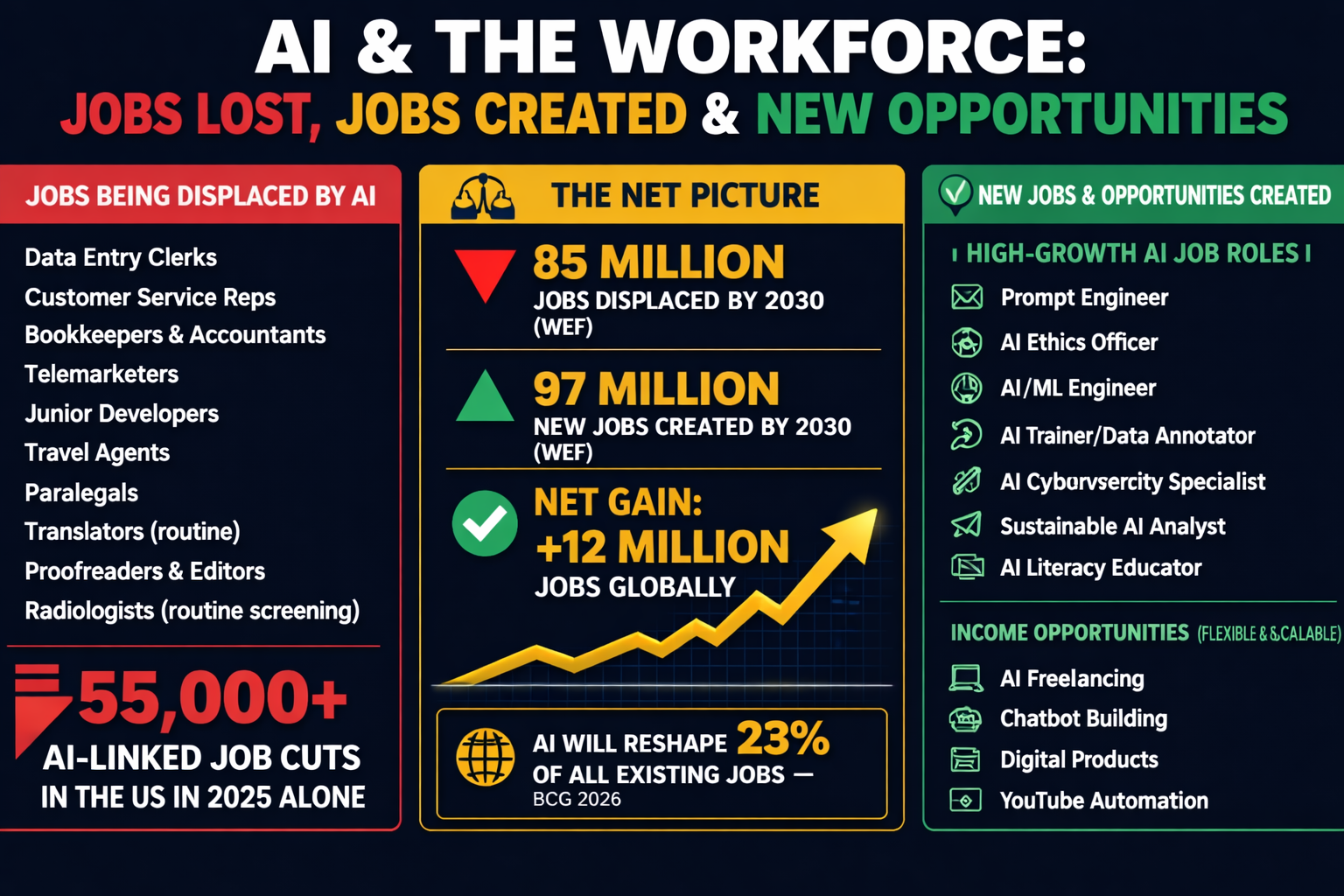
The relationship between AI and human labor is the defining economic story of our generation. For the first time in history, a single technology is simultaneously disrupting white-collar knowledge work, blue-collar manufacturing, and creative industries, all at the same time, and all at breathtaking speed. Previous waves of automation, from the Industrial Revolution to the computer era largely targeted one sector at a time, giving societies decades to adapt. AI is giving us years, not decades.
The impact is not uniform. While millions of routine, screen-based jobs face displacement, AI is simultaneously creating entirely new categories of work, elevating the value of human judgment, and expanding economic opportunity in ways that were unimaginable just five years ago. The World Economic Forum’s latest projections tell a nuanced story: 85 million jobs displaced globally by 2030, but 97 million new roles created a net gain of 12 million jobs, provided workers can bridge the skills gap in time. The critical question for every worker, student, and policymaker is not whether AI will change the workforce – (it already has) but how fast, how equitably, and how prepared we are to navigate that change.
Companies Already Laying Off Workers Due to AI
The numbers are no longer speculative. According to consulting firm Challenger, Gray & Christmas, AI accounted for nearly 55,000 job eliminations in the United States in 2025 alone, the highest rate since COVID-19. Here are the documented cases:
Microsoft: Cut 15,000 jobs throughout 2025, with CEO Satya Nadella revealing that AI now writes 20–30% of Microsoft’s code
Amazon: Eliminated 14,000 corporate positions, its largest layoff ever, as CEO Andy Jassy warned AI would reduce headcount significantly
Meta: Confirmed in May 2026: 8,000 employees cut (10% of its global workforce) as it redirects resources toward a $135 billion AI investment budget
IBM: Cut 9,000 jobs, primarily in HR, as AI chatbots directly replaced administrative functions
Salesforce: Eliminated 4,000 customer support positions after CEO Marc Benioff confirmed AI was handling 30–50% of Salesforce’s work
Klarna: Replaced its entire customer service department with AI, reducing its workforce from 5,000 to under 2,000
Workday: Cut 1,750 jobs (8.5% of workforce) to free up resources for AI investment
Duolingo: Ended relationships with hundreds of freelance content creators, replacing them with AI-generated language content
These are not small companies. These are global industry leaders setting the template for what every organization will eventually do. The message is unambiguous: AI is not coming for jobs; it is already here.
What Jobs Are Most at Risk and Which Are Safe?
The most vulnerable roles share a common trait: they are primarily performed on a screen and involve structured, repeatable tasks. Here are the jobs most exposed to AI displacement:
High Risk:
- Data entry and processing clerks
- Customer service representatives
- Proofreaders and editors
- Travel agents and ticket clerks
- Bookkeepers and accounting clerks
- Paralegals and legal assistants
- Telemarketers
- Junior software developers
- Journalists covering routine beats (earnings, sports scores, weather)
- Translators and interpreters (routine, non-cultural work)
Lower Risk; More Protected:
- Skilled trades (electricians, plumbers, carpenters)
- Healthcare workers (nurses, surgeons, physiotherapists)
- Mental health professionals and therapists
- Childcare and social workers
- Relationship-based financial advisors
- Creative directors and brand strategists
- AI engineers and cybersecurity specialists
- Teachers and educational facilitators
- Community educators and settlement service professionals
The critical nuance: AI is currently automating tasks within jobs more than replacing entire jobs. The biggest immediate impact is on entry-level positions where workers perform the routine, lower-judgment portions of a role. The workers most at risk are not those doing hard things — they are those doing the same thing repeatedly.
New Jobs Created by AI
Crucially, LinkedIn data confirmed that AI has already added 1.3 million new jobs globally even as it displaces others. Here are the brand-new careers the AI era has generated:
Prompt Engineer — Crafts precise AI instructions for optimal outputs; earns $100K–$175K
AI Ethics Officer — Governs fairness, transparency, and legal compliance of AI systems; earns $120K–$200K
AI/ML Engineer — Builds and deploys AI models; earns $130K–$220K
AI Trainer / Data Annotator — Labels and curates training datasets that teach AI how to behave
AI Maintenance Specialist — Manages AI-driven machines in industrial settings
AI Cybersecurity Specialist — Defends systems against AI-powered threats
Sustainable AI Analyst — Ensures AI deployment aligns with energy and environmental goals
AI Literacy Educator — Teaches individuals and organizations how to use AI effectively and ethically
Beyond entirely new roles, AI is transforming existing jobs into hybrid positions. Doctors are becoming AI-augmented clinicians. Financial advisors are becoming AI-enhanced wealth managers. Teachers are becoming AI-facilitated learning guides. Marketers are becoming AI campaign strategists. The job title may stay the same, but the skills required are evolving rapidly.
What Goldman Sachs, Deloitte, and KPMG Are Saying
The world’s most influential financial and consulting institutions have weighed in and their findings deserve serious attention.
Goldman Sachs projects that generative AI could substitute up to one-fourth of all current work tasks globally, potentially affecting 300 million jobs in the long run. However, their 2025 updated analysis found that at full adoption, AI could boost global labor productivity by 15% and add $7 trillion to global GDP suggesting the productivity gains will eventually offset the displacement pain.
Deloitte’s 2025 Global Human Capital Trends report found that 60% of workers already think of AI as a co-worker, that 59% of executives expect AI to replace entry-level jobs within the year, and that 70% of workers are more likely to stay with an employer that supports them in thriving in an AI environment. Deloitte’s central message: AI is reassigning tasks, not replacing people but shifting the nature of work from execution to judgment and creativity.
KPMG took the most practically focused stance: technology alone does not drive transformation, it is about how people adopt and adapt to it. In a bold internal move, KPMG began rating its own staff on AI usage in annual performance reviews in 2026, tracking Copilot engagement and AI tool adoption as part of each employee’s evaluation. In Canada specifically, 90% of employees reported that generative AI tools enhanced the quality of their work. KPMG’s newest insight: workers must learn to “coach their AI” giving it feedback the way a good manager develops a team member.
How AI Is Impacting Developing Countries

The global AI market is projected to reach $4.8 trillion within a decade: roughly the size of Germany’s entire economy. Yet the benefits are extremely concentrated. High-income countries, representing just 17% of global population, control 87% of notable AI models, 86% of AI startups, 91% of venture capital, and 77% of data center capacity.
The Opportunities Are Real:
AI precision farming tools are helping smallholder farmers in Sub-Saharan Africa and South Asia increase yields, detect crop disease, and manage water efficiently
AI diagnostic tools are filling physician gaps; detecting tuberculosis, malaria, and eye disease in rural areas with one doctor per 10,000 people
AI-powered fintech is expanding financial access for the unbanked using alternative credit data like mobile usage history
AI personalized learning tools are delivering quality education in local languages where qualified teachers are scarce
The Threats Are Equally Real:
Developing countries are losing their core competitive advantage i.e. cheap labor, as AI automation makes reshoring economically rational for multinationals
Less than 27% of people in low-income countries are online, leaving them structurally excluded from AI adoption
118 countries, mostly in the Global South, have no seat at major AI governance tables
Content moderators in Africa and South Asia are paid as little as $1.50/hour to do the traumatic work that makes AI systems safe for Western users
Global AI Adoption: Who Is Leading, Who Is Lagging
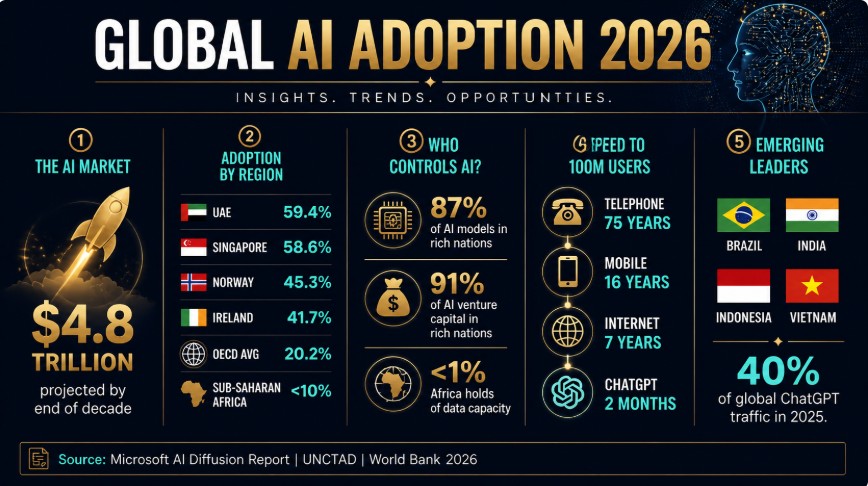
Microsoft’s AI Diffusion Report (2026) reveals that AI adoption rates vary dramatically across the world:
UAE; 59.4% adoption rate
Singapore; 58.6% adoption rate
Norway; 45.3%
Ireland; 41.7%
OECD Average; ~20%
Sub-Saharan Africa; Below 10% in many nations
The Global North’s adoption rate is now 10.6 percentage points higher than developing economies and this gap is widening, not closing. In mid-2025, more than 40% of ChatGPT’s global traffic came from just four middle-income countries: Brazil, India, Indonesia, and Vietnam suggesting that the Global South is hungry for AI tools, but access remains the bottleneck.
How to Get Educated About AI
Getting educated about AI has never been more accessible. The landscape spans free beginner courses to formal university degrees.
Completely Free Programs (Start Today):
Elements of AI (University of Helsinki): 6 hours, no math required, 25+ languages, 2 million+ graduates worldwide. Perfect for absolute beginners
Harvard CS50’s Introduction to AI; Full 7-week Harvard course, free to audit
Google AI Essentials (Coursera); 10 hours, free to audit
Microsoft Learn AI Fundamentals; 8 hours of completely free content
IBM SkillsBuild AI Courses; Free with digital badges
Vanderbilt Prompt Engineering; 6-module beginner course, free
Khan Academy AI for Education; Excellent for educators
Google Grow AI; Free AI tools and courses for professionals and business owners
Formal University Programs in Canada:
Université de Montréal: Home of Mila, the world’s largest academic AI research center; offers MSc, PhD, Graduate Diplomas, and a Certificate in Responsible AI Use
University of Waterloo: World-class AI and computer science programs
University of Toronto: One of the world’s top AI research institutions
University of Alberta: AI-related continuing education programs through ALIS
The key insight: You do not need a degree to use AI effectively. You need AI literacy, a basic understanding of what AI can do, what it cannot do, and how to apply it wisely in your field. That takes a few hours of a free course, not four years of university.
Do You Need to Be Educated in AI to Use It?
The answer is a clear no. Every major AI tool such as ChatGPT, Google Gemini, Microsoft Copilot, Perplexity, runs in a web browser or mobile app. There is nothing to install, no code to write. You ask questions in plain English the same way you would ask a knowledgeable colleague. The one genuinely important skill is critical thinking; the ability to verify what AI tells you, because AI tools can and do make mistakes.
You are also almost certainly already using AI without realizing it: Gmail’s autocomplete, Spotify’s recommendations, Google Maps’ traffic predictions, your bank’s fraud detection, LinkedIn’s job suggestions; all of these are AI. The revolution is not coming. It is already here, quietly running in the background of your daily life.
Ethical Challenges and Governance in an AI-Driven Society

As AI embeds itself into courts, hospitals, financial systems, and governments, the ethical and governance challenges it raises are immediate and consequential for every citizen.
The Core Ethical Challenges:
Bias and Discrimination: AI industrializes historical prejudice at scale, creating unfair outcomes in hiring, lending, policing, and healthcare
Privacy and Surveillance: AI enables mass behavioral tracking and monitoring that threatens fundamental civil liberties
The Black Box Problem: High-stakes AI decisions cannot be explained or challenged by those affected
Accountability Gaps: When AI causes harm, existing legal systems have no clear framework for assigning responsibility
Deepfakes and Misinformation: Generative AI has made it trivially easy to fabricate realistic audio, video, and images of real people
Environmental Cost: Training a single large AI model can consume the lifetime electricity use of 100 American homes
Concentration of Power: A handful of US tech companies are making civilization-shaping decisions about AI with minimal democratic accountability
The Global Governance Response:
The EU AI Act: The world’s first comprehensive binding AI law, fully in effect in 2026, classifying AI systems by risk level and imposing strict requirements on high-risk applications in hiring, credit, healthcare, and law enforcement
The United States: A lighter-touch, innovation-first approach under President Trump, with sector-by-sector regulation rather than a unified national framework, viewing excessive regulation as a competitive threat against China
China: State-directed governance: specific regulations on generative AI, deepfakes, and algorithmic recommendations, while massively accelerating national AI investment
The Global South: Largely excluded from major AI governance discussions, with 118 countries having no representation at the major decision-making tables
The bottom line: AI governance is not just a policy problem. It is a civic literacy problem. Every person affected by AI decisions, which is everyone, has a stake in understanding their rights and demanding accountability.
Financial Opportunities AI Creates for Individuals
AI has created an unprecedented democratization of income opportunity. A one-person operation can now produce the output of a 10-person team, and individuals with no formal technical background are building profitable income streams in weeks.
Service-Based Income (Fastest to Start):
AI-Powered Freelancing: Writing, editing, research, and admin at 3–5x normal speed; earn $20–$150+/hour on Upwork and Fiverr
AI Social Media Management: Manage 5–10 business accounts simultaneously using ChatGPT + Canva + Buffer; earn $1,000–$5,000/month
AI Website Building: Build professional sites with Framer, Wix AI, or Webflow; charge setup fees plus monthly retainers
Custom AI Chatbot Building: No-code platforms like Voiceflow allow anyone to build business chatbots; earn $500–$5,000 per project
AI Translation Services: Especially valuable for multilingual newcomers; combine AI translation with cultural fluency
Digital Products (Scalable Passive Income):
E-books and financial guides
Canva templates and prompt libraries
Online courses and workshops
Print-on-demand AI art and merchandise
Niche research reports and paid newsletters
Teaching and Educating About AI:
This is arguably the highest-leverage opportunity of all in 2026. Companies are paying AI training consultants $1,000–$10,000+ per day to train their teams. Building niche educational content for different stakeholders for example “AI for Financial Advisors,” “AI for Realtors”, “AI for small businesses”, combines expertise with massive market demand.
How Retail Investors and Day Traders Can Use AI

For decades, institutional traders had an insurmountable edge over retail investors, armies of analysts, proprietary data feeds, and quantitative models built by PhDs. AI is rapidly democratizing access to those tools. The Ontario Securities Commission (OSC) confirmed in its own study that AI is creating “considerable value for retail investors” through reduced costs, better access to analysis, and improved decision-making.
The Key Benefits for Traders:
Superior Research: AI scans thousands of earnings reports, filings, and news sources in seconds, flagging the highest-probability setups before a chart is even opened
Sentiment Analysis: Real-time scanning of millions of social media posts, news headlines, and analyst notes to gauge crowd sentiment for individual stocks
Predictive Earnings Analysis: Research published in ScienceDirect confirmed that AI systems make more accurate predictions of earnings changes than human analysts, the core engine of Post-Earnings Announcement Drift (PEAD) strategies
Options Flow and Dark Pool Tracking: Tools like Unusual Whales and FlowAlgo surface significant institutional positioning in real time
Pattern Recognition: AI identifies technical setups across thousands of charts simultaneously, presenting only the highest probability candidates for human review
Risk Management: Dynamic position sizing and stop-loss calculations based on your rules, account size, and VIX conditions, removing emotion from the equation
Best AI Tools for Retail Traders:
Trade Ideas: AI stock scanner and real-time trade signals ($84–$228/month)
Unusual Whales: Options flow, dark pool data, congressional trades ($30–$50/month)
TradingView: AI-assisted charting and Pine Script strategy builder (free–$60/month)
IBKR: AI-powered options analytics, algorithmic trading, stock scanner
QuantConnect: Algorithmic strategy building and back testing
The Risks to Know:
AI Herding: When thousands of traders use the same AI signal, everyone enters the same trade simultaneously: the edge disappears when it becomes crowded
Overfitting: AI back tests can look perfect on historical data but fail on live markets
False Confidence: Always apply your own judgment; AI outputs can be authoritative-sounding even when wrong
The traders who will thrive are those who use AI as a research multiplier and signal filter not an autopilot. The human edge remains in interpreting context, managing psychology, and making the final judgment call.
AI Is Here to Stay; Embrace It

Every major transformative technology in history followed the same arc: fear, resistance, adaptation, and normalization. The printing press, the industrial revolution, electricity, the automobile, the personal computer, the internet; all were feared as destroyers of jobs and social order. All eventually became invisible infrastructure.
AI is following the same path. The Knight Columbia Institute published a landmark 2025 paper arguing that AI should be understood as “normal technology”, transformative and powerful, but subject to the same forces of regulation, competition, and human adaptation that all major technologies have faced. Northwestern University’s 2025 analysis confirmed: “AI is reshaping everyday life the same way the internet did in the 1990s, beginning as a novelty, becoming a utility, ending as invisible infrastructure”.
The workers, students, entrepreneurs, and nations that lean into AI with curiosity, critical thinking, and adaptability will shape the next era. Those who wait on the sidelines will find the world has moved on without them.
The formula for thriving in the AI era is not complicated:
Use AI as a tool, not a crutch
Keep the human judgment that AI cannot replicate
Commit to continuous learning, the half-life of skills is shrinking
Build the human skills that AI cannot touch: empathy, creativity, relationships, and ethics
Start today; the best time to begin was yesterday; the second best time is right now
Final Thoughts
AI is neither the apocalypse nor the utopia. It is a general-purpose technology, like electricity, that will amplify human capability enormously, create new industries, displace old ones, and become so embedded in daily life that future generations will find it as unremarkable as smartphones.
The workers most at risk are not those doing hard things. They are those doing the same thing repeatedly and refusing to adapt. The opportunity belongs to those who ask: “How do I use AI to do what I already do; better, faster, and at greater scale?”
At Thrive Nation Finance, our mission is to ensure that newcomers to Canada, working Canadians, and underserved communities are not left behind in this transformation. Financial literacy, career resilience, and AI readiness are no longer separate conversations; they are the same conversation. And that conversation starts here.
Share this article with someone who needs to hear it. The future belongs to the prepared.
© 2026 Thrive Nation Finance | Toronto, Ontario, Canada
Financial Education – Settlement Services – Economic Empowerment