
The Pick and Shovel Strategy: The Smartest Way to Invest in the AI Boom
Every few decades, a technology comes along that changes everything. The internet did it in the 1990s. Smartphones did it in the 2000s. Today, Artificial Intelligence (AI) is doing it again and millions of investors are rushing in, desperate not to miss the next big thing.
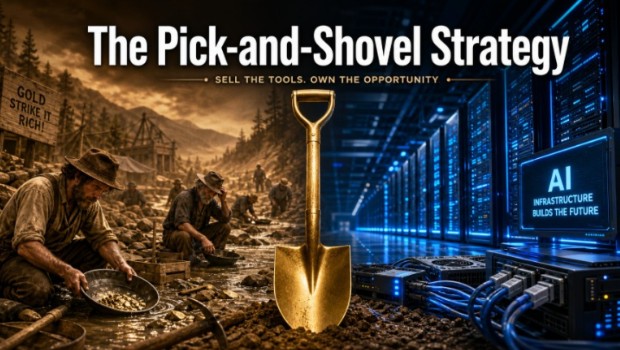
By Gabriel / May 10, 2026
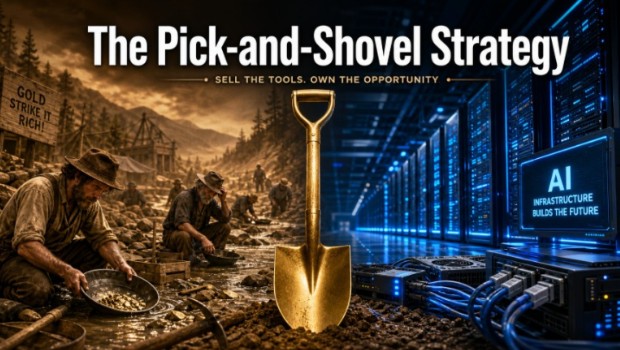
By Gabriel Gachange | Thrive Nation Finance
Introduction: The Secret the Smart Money Knows
Every few decades, a technology comes along that changes everything. The internet did it in the 1990s. Smartphones did it in the 2000s. Today, Artificial Intelligence (AI) is doing it again and millions of investors are rushing in, desperate not to miss the next big thing.
But here is the uncomfortable truth: most people who chase the hottest trend end up losing money.
There is, however, a smarter way to invest in a boom one that has worked consistently for over 175 years. It is called the Pick-and-Shovel Strategy, and once you understand it, you will never look at investing the same way again.
Part 1: The Story Behind the Strategy; The California Gold Rush
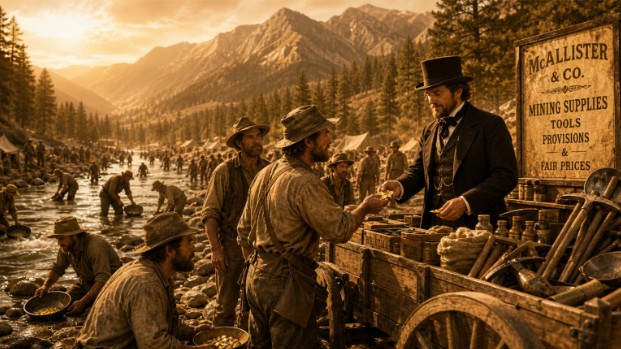
In January 1848, a carpenter named James Marshall spotted gold flakes in a river in California. Word spread fast. By 1849, over 300,000 people had flooded into California from across America, Europe, and Asia all chasing the dream of striking it rich. They became known as the “Forty-Niners.”
The frenzy was real. The gold was there. But the uncomfortable truth? Most miners went broke.
Mining was brutally hard, expensive, and competitive. Equipment broke down. Men worked for months in freezing rivers and came back with almost nothing. The vast majority of gold rush participants left California poorer than when they arrived.
The People Who Actually Got Rich
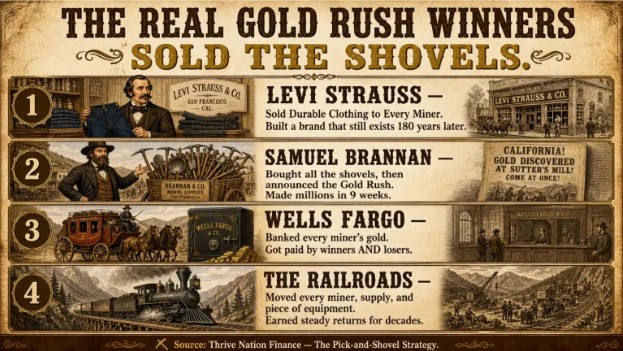
While miners were gambling everything on finding gold, a different group of people was quietly making fortunes, not by mining, but by selling to the miners.
Levi Strauss was a merchant who sold durable trousers to miners. He became a millionaire while most miners went broke. His company, Levi’s, still exists today, nearly 180 years later.
Samuel Brannan bought up every pick, shovel, and mining pan he could find before publicly announcing the gold discovery. When the rush hit, he was the only vendor. He reportedly made the equivalent of millions of today’s dollars in just nine weeks by selling shovels to the very men chasing the gold he had hyped.
Wells Fargo recognized that miners needed somewhere to deposit their gold and send money home. Banking services became enormously profitable because every single miner needed them, whether winner or loser.
The Railroad Companies recognized that someone had to move people, food, and equipment into California. The companies that built those railroads made consistent, compounding returns for years, regardless of how many miners succeeded.
The Core Lesson
Mark Twain, who himself tried and failed at silver mining, captured this truth perfectly: “During a gold rush, it’s a good time to be in the pick and shovel business.”
The miners were making a binary bet; either you find gold, or you don’t. Most didn’t.
The shovel sellers were making a smarter bet, as long as someone keeps mining, I keep selling. They didn’t need to know which miner would strike it rich. They just needed the rush to continue.
Part 2: What Is the Pick and Shovel Strategy in Investing?
In the stock market, the pick-and-shovel strategy means this: instead of buying the companies competing in a hot industry, you buy the companies that supply the tools, technology, and infrastructure that every competitor in that industry must use.
You are not betting on who wins the race. You are betting on the company that sells the running shoes to every single racer.
When everyone was building websites in the 1990s, Cisco sold the routers every website needed. When thousands of oil companies were drilling in the 2000s, Schlumberger sold the drilling equipment every well required. When hundreds of phone brands were competing in the 2010s, TSMC made the chips every single phone needed to function.
Today, as hundreds of AI companies race to build the next breakthrough model, a new generation of shovel sellers is quietly getting rich and most everyday investors have never heard of them.
Part 3: This Pattern Has Repeated in Every Major Boom
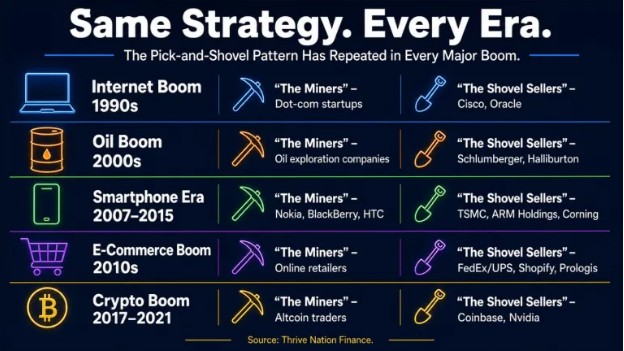
The pick and shovel story is not just history. It has played out in every major investment boom in modern times, and the pattern is always the same.
The Internet Boom (1990s)
Thousands of dot-com companies promised to change the world. Most went to zero when the bubble burst in 2000. But Cisco Systems which made the routers and networking equipment every website and internet provider had to use grew from a $1 billion company to a $500 billion company during the boom. Oracle sold databases to every company building an online presence and survived the crash as one of the world’s most dominant software companies. They sold the shovels. The dot-coms chased the gold.
The Oil Boom (2000s)
When oil prices surged, hundreds of exploration companies rushed to drill new wells. Most struggled when oil prices eventually fell. But Schlumberger and Halliburton, which provided drilling technology and oilfield services, got paid for every single well drilled, regardless of what happened to oil prices. They locked in contracts and earned steady fees while the explorers took all the risk.
The Smartphone Era (2007–2015)
Phone brands Nokia, BlackBerry, and HTC competed fiercely and most eventually failed or faded into irrelevance. But TSMC fabricated chips for every phone brand and didn’t care who won market share. ARM Holdings collected a royalty on every chip sold, from every manufacturer, in every country. Corning supplied the glass screen to virtually every phone ever made. They sold the shovels. The phone brands chased the gold.
The E-Commerce Boom (2010s)
Most small online retailers failed trying to compete against Amazon. But FedEx and UPS delivered every package from every merchant, they got paid regardless of which store won. Shopify provided the storefront platform to hundreds of thousands of sellers. Prologis owned the warehouses storing every merchant’s inventory. They sold the infrastructure. The retailers chased the customers.
The Cryptocurrency Boom (2017–2021)
Most altcoins went to zero. But Coinbase charged transaction fees every time anyone bought or sold any crypto it didn’t matter which coin won. Nvidia sold graphics cards used for crypto mining, and demand for its hardware surged regardless of which cryptocurrency was popular. They sold the tools. The traders chased the tokens.
The pattern never changes. The gold rush changes. The wisdom of selling shovels stays the same.
Part 4: The AI Boom; Today’s Gold Rush
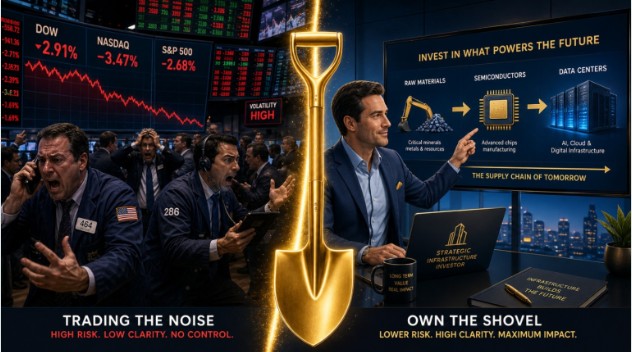
Today, Artificial Intelligence is the gold rush. Hundreds of companies are racing to build AI models, AI applications, and AI-powered products. Most will not survive as standalone businesses. The competition is fierce, the costs are staggering, and only a few will win.
But the companies building the infrastructure that all of them depend on? They get paid by everyone the winners and the losers alike.
Wait; Is Nvidia an “AI Stock”?
This is one of the most common and costly misconceptions in investing today. When people hear “AI stock,” they immediately think of Nvidia. But Nvidia is not an AI company.
Nvidia does not build AI models. It does not sell AI software. It does not run AI services for consumers or businesses. Nvidia is a semiconductor hardware company, founded in 1993, originally making graphics cards for video gamers. It just so happens that its chips are perfectly designed for running AI workloads.
Nvidia is the shovel seller of the AI gold rush. It does not care whether ChatGPT or Google Gemini wins the AI race. As long as both keep training larger and more powerful models, both will keep buying more Nvidia chips. That is the pick-and-shovel power at work.
The same logic applies to many companies that get mislabeled as “AI stocks.” Microsoft is an enterprise software and cloud infrastructure company. Arista Networks is a networking equipment manufacturer. Vertiv makes power and cooling systems for data centers. Seagate makes hard disk drives for data storage. None of them do AI as their core business; they supply the infrastructure that AI runs on.
Always ask what a company actually does before you buy it based on a trending label. The label “AI stock” has been applied so broadly it has become almost meaningless.
Why AI Data Centers Need So Much Power
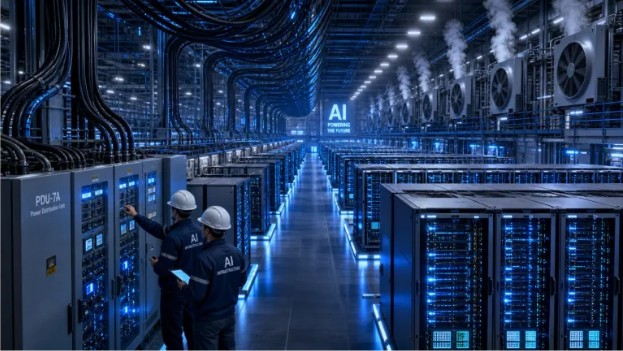
Here is something that surprises most people: the AI boom is not just a technology story, it is an energy story.
AI data centers consume a shocking amount of electricity. A regular server rack in a traditional data center uses about 8 to 15 kilowatts of power. An AI server rack uses 30 to 150 kilowatts, up to ten times more. A single Nvidia Blackwell GPU chip consumes 1,200 watts on its own equivalent to running twelve hair dryers simultaneously, from just one chip. A single server blade holds eight of these chips, drawing nearly 10,000 watts per blade. A full AI rack can hold ten blades.
Goldman Sachs estimates global data center power demand will grow 165% by 2030. Running a single large AI model consumes as much electricity in a year as 120 average homes.
This creates a massive, often overlooked pick-and-shovel opportunity in the companies supplying electricity, cooling systems, and grid infrastructure to data centers. Most investors are so focused on chip stocks that they completely miss this layer which means it is often better value.
Part 5: How to Find Pick and Shovel Plays in Any Trend
You can apply this strategy to any future boom, not just AI. Here is a simple framework:
Step 1 — Confirm the trend is real and large. Is serious money flowing in? Are major companies committing billions? Does the trend have at least a 5 to 10 year growth runway ahead of it?
Step 2 — Identify the most visible competitors. Who are the companies everyone is talking about? Who is racing to win? These are your miners.
Step 3 — Ask what every single one of them must buy. Think about the hardware they need, the software platforms they build on, the energy that powers their operations, and the services they need to keep running. What inputs can none of them go without?
Step 4 — Look for dominant suppliers. The best pick-and-shovel companies have very few competitors, make it difficult for customers to switch away from them, and serve many different companies not just one.
Step 5 — Check the financials. Is revenue growing alongside the trend? Are profit margins strong? Does the company have too much dependence on any single customer?
Step 6 — Go deeper in the supply chain. The most overlooked opportunities are often two or three layers below the obvious names. Less hype, lower valuations but the same exposure to the trend’s growth.
Part 6: The Risks; Pick and Shovel Is Not Risk-Free
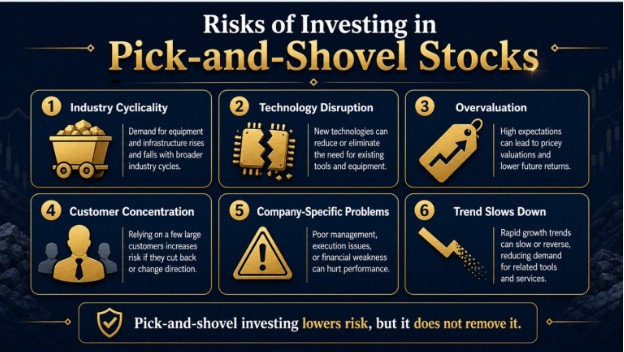
No investment strategy is without risk, and it is important to be honest about the downsides.
Industry cyclicality is the biggest danger. Pick-and-shovel companies are still tied to the health of the industry they supply. If the trend weakens and the end-product companies cut their spending, the suppliers feel the pain too.
Technology disruption is a real threat. A new invention could make the current shovel obsolete. If AI suddenly required ten times fewer chips to run the same models, Nvidia’s dominant position would weaken significantly.
Overvaluation is a trap many investors fall into. Once everyone identifies the pick-and-shovel play, the price gets bid up and future returns shrink. You may end up paying a premium for safety that no longer exists at that price.
Customer concentration is dangerous for suppliers who depend on just one or two big clients. Losing a single major customer can be devastating to revenue.
Company-specific problems such as management failures, accounting scandals, or legal issues, can hurt any stock regardless of how well the broader trend is performing.
The bottom line: pick-and-shovel investing reduces risk compared to chasing hot end-product companies, but it does not eliminate risk. Every investment still demands careful research.
Part 7: 5 Pick and Shovel Stocks for Beginner Investors (5–10 Year Hold)

These five stocks are chosen for their financial strength, dominant market positions, and long runway of growth designed for a beginner building a medium-to-long-term portfolio.
1. Taiwan Semiconductor Manufacturing (Ticker: TSM)
TSMC manufactures the physical chips that go inside virtually every AI system, smartphone, and computer in the world. Companies like Nvidia, Apple, Qualcomm, and AMD all rely on TSMC to build their chips. No other company on earth can manufacture chips at their level of precision and scale.
TSMC raised its 2026 revenue growth forecast to over 30% and is investing between $52 and $56 billion in expansion. As AI models grow bigger and more powerful, they need more chips and TSMC makes them all. It doesn’t matter which AI company wins the race. They all come to TSMC.
Think of TSMC as the factory that forges every gold-rush shovel in the world. It doesn’t matter who designed the best shovel they all need TSMC to build it.
2. Broadcom (Ticker: AVGO)
Broadcom designs custom AI chips known as ASICs and critical networking equipment. Google, Meta, and Apple all use Broadcom’s custom chips because they are more efficient and cost-effective than general-purpose chips for specific tasks.
AI chip revenue at Broadcom is projected to double year-over-year, with overall revenue growth forecast at 124% in 2026. As the biggest AI companies build ever-larger systems, they need customized silicon and Broadcom is the specialist.
If Nvidia sells standard shovels, Broadcom makes bespoke, custom-engineered shovels for the biggest mining operations faster, cheaper, and tailored precisely to what each customer needs.
3. Microsoft (Ticker: MSFT)
Microsoft owns Azure, one of the world’s largest cloud platforms, which hosts AI workloads for thousands of businesses globally. It is also the exclusive commercial partner of OpenAI, the maker of ChatGPT. Every company building an AI product needs computing infrastructure to run it on and most choose Microsoft Azure.
Microsoft earns revenue from every AI application deployed on its cloud, regardless of which AI model wins the market. It also pays a growing dividend, making it suitable for investors who want both growth and income over a long-term horizon.
Microsoft owns the land where all the miners are digging. Every miner pays rent and Microsoft collects it from everyone.
4. Vertiv Holdings (Ticker: VRT)
Vertiv makes the power distribution and cooling systems installed inside data centers. As AI chips generate extreme heat during operation, every data center needs advanced cooling technology to keep servers running safely. Without Vertiv’s systems, the physical AI infrastructure simply cannot function.
AI data center construction is accelerating globally, and every new facility requires Vertiv’s equipment. Because it is a less well-known name than the headline chip stocks, it often trades at better value which matters greatly for long-term returns.
Vertiv supplies the ventilation and water systems for the gold mines. No mine can operate in extreme heat without them but most investors don’t think about the cooling company until the mines start overheating.
5. Seagate Technology (Ticker: STX)
Seagate manufactures hard disk drives that store the enormous amounts of data AI systems generate, process, and need to access. Every AI model trained produces terabytes of data that must be stored somewhere permanently and retrieved quickly.
Seagate was one of the best-performing AI-related stocks over the past year with a one-year return reaching 691% at its peak yet most everyday investors have never heard of it. As AI scales up, data storage demand scales with it. Seagate is a quiet, durable, long-term beneficiary that flies well below the radar.
Seagate builds the vaults where all the gold is stored. Every mining operation needs a vault, but nobody glamourizes the vault-builder.
Part 8: 3 Pick-and-Shovel ETFs for Beginners
If researching and picking individual stocks feels overwhelming, ETFs (Exchange Traded Funds) are a brilliant alternative. An ETF lets you own a whole basket of pick-and-shovel companies in a single, simple purchase. You get instant diversification across many companies without needing to research every one of them individually.
Think of it like this: instead of buying one shovel company, you buy the entire shovel store.
ETF #1: iShares Future AI & Tech ETF (Ticker: ARTY)
ARTY is the best value option for US-based investors wanting broad, low-cost AI infrastructure exposure. It carries the lowest annual fee (0.47%) among focused AI ETFs; meaning you keep more of your returns each year. It delivered an 84% one-year return as of early 2026, one of the strongest performances in its category. It holds semiconductor companies and international chip stocks, giving you exposure across multiple infrastructure layers simultaneously.
ETF #2: Global X Data Center & Digital Infrastructure ETF (Ticker: DTCR)
DTCR is ideal for investors who want exposure to AI real estate and physical infrastructure rather than just chips. It owns data center REITs; companies that own and rent out the actual physical buildings where AI servers live. These companies collect long-term rental income from Google, Amazon, and Microsoft. DTCR was up 35% year-to-date as of late 2025, pays regular dividends, and carries a reasonable 0.50% annual fee.
ETF #3: VanEck Semiconductor ETF (Ticker: SMH)
SMH is one of the most established and widely respected semiconductor ETFs available. It carries the lowest annual fee of the three (0.35%) and focuses deeply on the chip supply chain that powers every AI system. Its top holdings include Nvidia, TSMC, ASML, Broadcom, and Applied Materials, the foundational layer of the entire AI buildout. For a beginner wanting concentrated, high-conviction exposure to AI infrastructure at low cost, SMH is a strong long-term choice.
Final Thought: Sell the Shovels, Not Chase the Gold
The California Gold Rush of 1848 and the AI boom of today are separated by nearly 200 years but the investment lesson is identical.
When everyone is chasing gold, sell the shovels.
You do not need to know which AI company will win. You do not need to predict whether ChatGPT, Google Gemini, or the next breakthrough dominates the market. You just need to identify the companies that all of them must buy from and own those.
That is the pick-and-shovel strategy. That is how patient, intelligent investors build lasting wealth while everyone else is gambling on headlines.
Gabriel Gachange is the founder of Thrive Nation Finance, a financial education and advisory company helping newcomers to Canada and everyday investors build lasting financial confidence.
Did you find this article helpful? Share it with someone who is just starting their investment journey. Follow Thrive Nation Finance on Facebook and LinkedIn for more practical financial education every week.
Disclaimer: This article is intended for educational and informational purposes only. It does not constitute financial advice, investment advice, or any form of professional recommendation. Nothing in this article should be interpreted as a solicitation or recommendation to buy, sell, or hold any security or financial product. All investing involves risk, including the possible loss of your principal investment. Past performance of any stock, ETF, or strategy does not guarantee future results. Individual investment decisions should be made based on your own personal financial situation, risk tolerance, and investment goals. Always consult a qualified and licensed financial advisor before making any investment decisions. Thrive Nation Finance is not responsible for any financial losses incurred as a result of information contained in this article.