
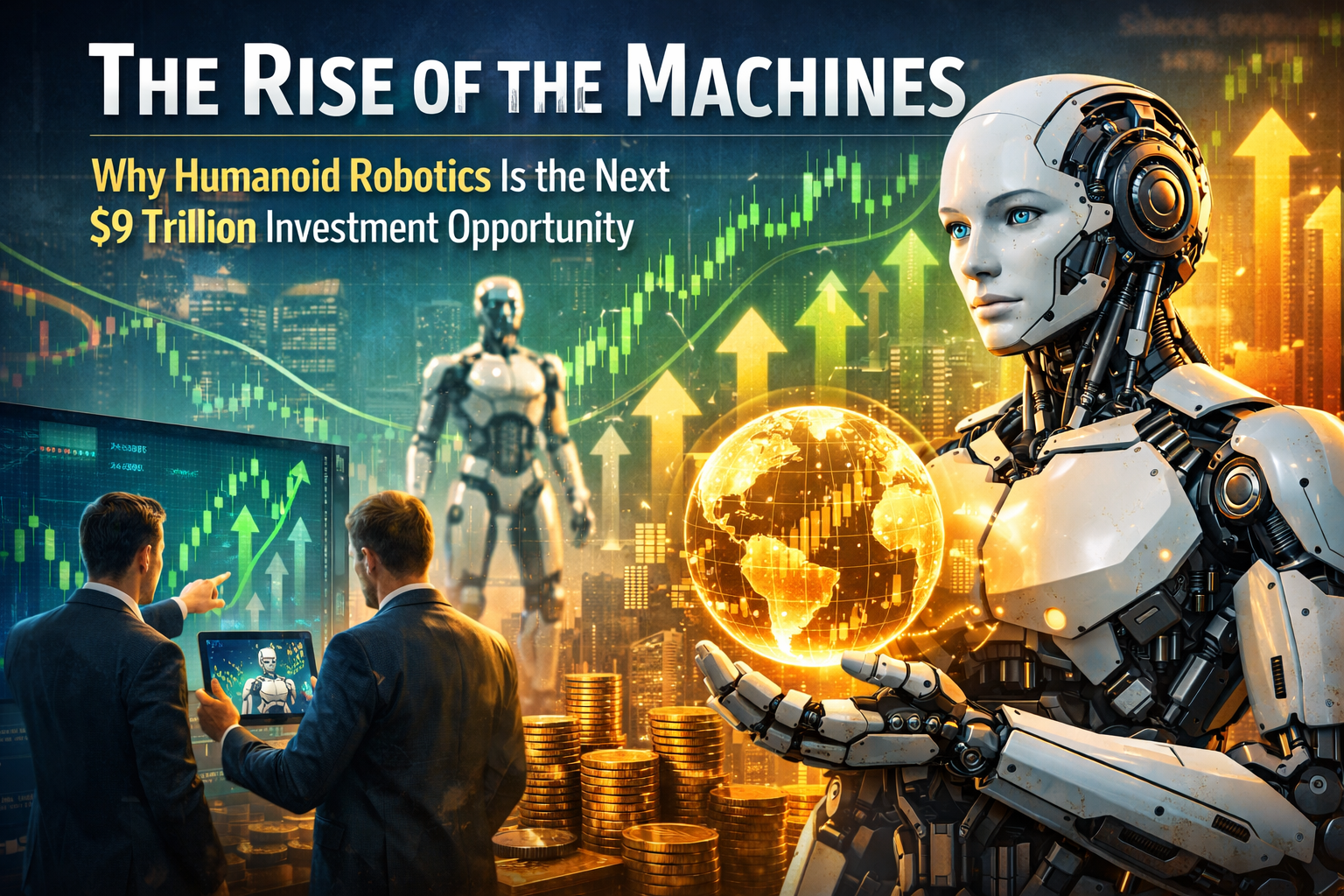
The Rise of the Machines: Why Humanoid Robotics Is the Next $9 Trillion Investment Opportunity
The idea of humanoid robots has long lived in the realm of science fiction but that era is over. Today, humanoid robotics is emerging as a foundational pillar of the next industrial revolution, with a projected $9 trillion total addressable market and a staggering 39% annual growth rate.
By Gabriel / April 27, 2026
The idea of humanoid robots has long lived in the realm of science fiction but that era is over. Today, humanoid robotics is emerging as a foundational pillar of the next industrial revolution, with a projected $9 trillion total addressable market and a staggering 39% annual growth rate.
The real question is no longer whether robots will become part of the global workforce, it’s how quickly they scale.
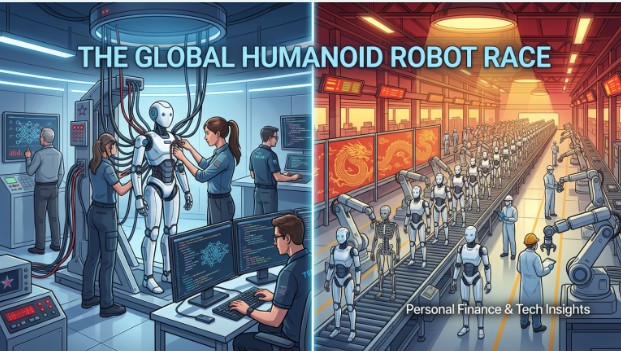
Across the world, more than 29 robotics manufacturers are racing to deploy general-purpose humanoid machines into industries facing severe labor shortages. From factory floors to warehouses and eventually homes the shift is already underway.
The Technology Powering the Shift
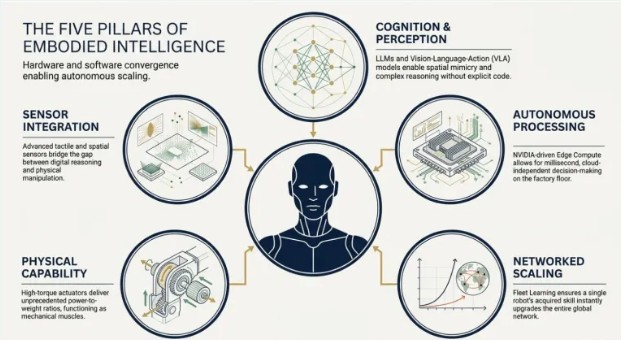
This acceleration is being driven by a convergence of breakthrough technologies.
Large language models (LLMs) act as the brain, enabling robots to understand natural language and make decisions without explicit programming. Vision-language-action (VLA) models allow robots to observe and replicate human tasks with precision.
On the hardware side, high-torque actuators provide strength and dexterity, while edge computing, powered by advanced chips, enables real-time decision making. Fleet learning then ties it all together, allowing robots to share knowledge instantly across entire networks.
From Lab to Real World
Humanoid robots are no longer experimental, they are already working.
Tesla’s Optimus is being deployed inside Gigafactories. Boston Dynamics’ Atlas is operating in industrial testing environments. Figure AI is working with BMW on factory tasks, while Agility Robotics’ Digit is active in logistics with Amazon.
This is the early stage of a much larger rollout.
The Global Power Shift
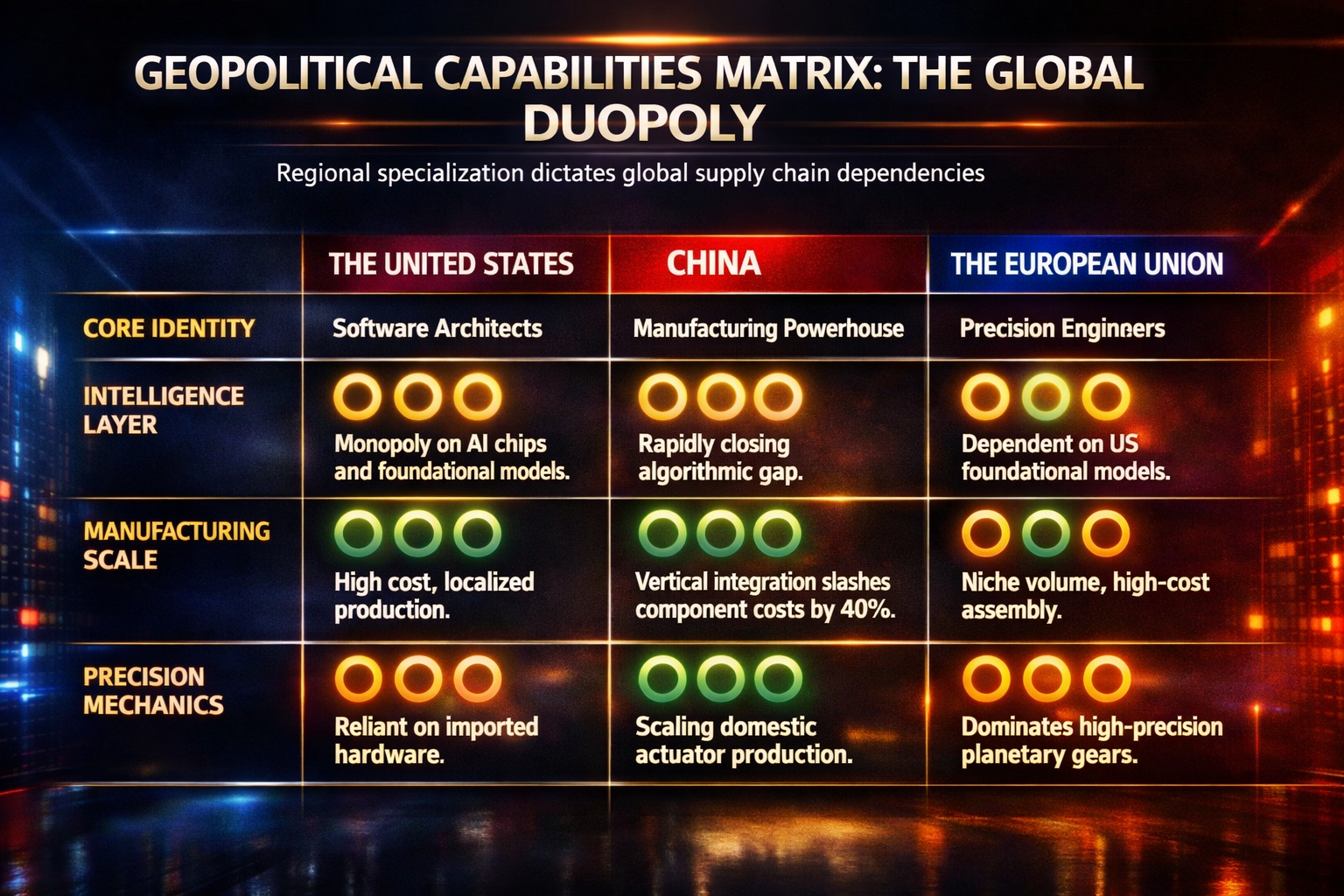
The humanoid robotics race is dominated by two global powers.
The United States leads in artificial intelligence and compute infrastructure, driven by companies like NVIDIA. China, meanwhile, dominates manufacturing and supply chains, producing key components at significantly lower cost.
Europe, particularly Germany, remains essential for precision engineering; supplying the high-performance components that enable fine motor control.
5 Public Companies Leading the Charge
For investors, several publicly traded companies offer direct exposure to the robotics and AI ecosystem:
- NVIDIA (NVDA): The backbone of AI compute, supplying chips and simulation platforms used across the robotics industry.
- Tesla (TSLA): A leader in real-world humanoid deployment with a clear path to mass manufacturing through its factory network.
- Amazon (AMZN): Actively integrating robotics into logistics and fulfillment, including partnerships with humanoid robot firms.
- Alphabet (GOOGL): A major force in AI development, providing foundational models and robotics research through DeepMind.
- Hyundai Motor Group (HYMTF): The parent company of Boston Dynamics, giving it direct exposure to advanced humanoid robotics development.
These companies represent different layers of the value chain, from AI infrastructure to real-world deployment.
2 ETFs for Diversified Exposure
For broader exposure without relying on individual winners, investors can look at sector-focused ETFs:
- ROBO (Global Robotics and Automation ETF): Provides diversified exposure to global robotics, automation, and AI companies.
- BOTZ (Global X Robotics & Artificial Intelligence ETF): Focuses on leading firms in robotics, AI, and industrial automation.
These ETFs reduce single-company risk while capturing overall sector growth.
Where the Money Is Flowing
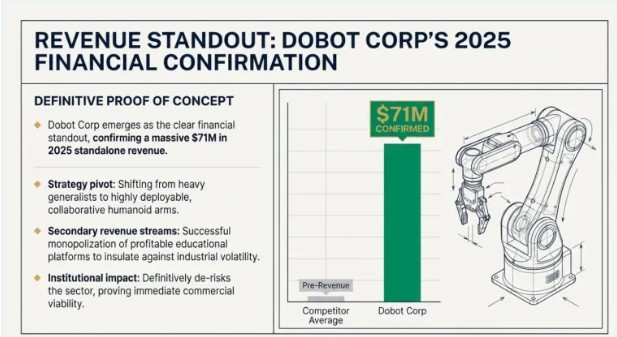
While many robotics firms are still in heavy investment mode, early revenue is beginning to emerge.
Dobot has reported $71 million in revenue, while companies like Figure AI and Agility Robotics are generating income through enterprise pilot programs.
However, the most consistent profits are currently being captured by infrastructure players like NVIDIA and key component manufacturers, highlighting where the value is being realized today.
The Road Ahead
The adoption of humanoid robotics will unfold in phases.
We are currently in the early deployment stage. Over the next decade, robots will scale across industrial environments, followed by mass production as costs fall below $30,000 per unit.
By the mid-2030s, robots will expand into service industries, and eventually, into everyday consumer life.
How to Position as an Investor
This is a multi-layered opportunity.
In the short term, infrastructure players like NVIDIA offer the most stable exposure. Over time, as humanoid robots move from pilot programs to full-scale deployment, companies like Tesla and others in manufacturing will become increasingly important.
For diversification, ETFs like ROBO and BOTZ provide balanced exposure across the ecosystem.
The Bottom Line
Humanoid robotics is no longer speculative, it’s becoming essential. Labor shortages, aging populations, and rising productivity demands are accelerating adoption.
At Thrive Nation Finance, we believe the intelligence phase is largely complete. The next phase; scaling, will define the winners.
The opportunity now is to position early, focusing on the companies building the infrastructure today and the manufacturers that will dominate tomorrow.
Disclaimer
This article is for informational purposes only and does not constitute financial advice. Investing in robotics and artificial intelligence involves significant risk, including the potential loss of capital. Always consult with a qualified financial advisor before making investment decisions.
© 2026 Thrive Nation Finance. All Rights Reserved.