
The Wealth Divide: What the Rich Know That You Were Never Taught
Have you ever wondered why some people seem to build wealth effortlessly while others work hard for decades and still struggle to get ahead? You’re not imagining it. The difference isn’t just hard work, talent, or ambition. It’s knowledge, access, and a system that was never designed to teach ordinary people how money really works. And that gap, the one nobody warned you about, is the reason the rich keep getting richer.

By Gabriel / May 30, 2026
A Thrive Nation Finance Signature Article

Have you ever wondered why some people seem to build wealth effortlessly while others work hard for decades and still struggle to get ahead? You’re not imagining it. The difference isn’t just hard work, talent, or ambition. It’s knowledge, access, and a system that was never designed to teach ordinary people how money really works.
And that gap, the one nobody warned you about, is the reason the rich keep getting richer.
The Money Conversation Schools Never Had Time For

Most of us grew up in a school system built during the Industrial Revolution. Its purpose was clear: produce skilled workers, professionals, and tradespeople to build society. And it succeeded. We got doctors, engineers, electricians, teachers, and accountants.
But something important was left out.
“You cannot teach what you were never given.”
Teachers weren’t hiding financial knowledge, they were never taught it either. They graduated, got jobs, earned salaries, paid bills, and hoped their pensions would be enough. They lived the same financial reality as their students’ parents.
So after all those years of schooling, most people still don’t know:
- How compound interest works
- The difference between an asset and a liability
- How to file taxes
- What a TFSA or RRSP actually does
- How to build wealth instead of just earning income
This wasn’t an individual failure. It was a structural omission, one that still affects millions today.
The good news? Financial knowledge is not locked behind a university degree. Anyone can learn it. At any age. At any income level. Starting today.
How the Rich Stay Rich
Wealthy people don’t just earn more; they own more.
They own:
- Stocks
- Real estate
- Businesses
- Investments that grow even while they sleep
This is the difference between earning money and owning money-making assets.
The Power of Compound Growth
Compound growth is the quiet engine behind generational wealth. Your money earns returns. Then those returns earn returns. Over time, it becomes an avalanche.
The wealthy understand this deeply. Most people were simply never taught it.
The Wealthy Don’t Fear Debt; They Leverage It
Here’s a truth almost nobody explains:
The wealthy use debt to build wealth. The poor use debt to survive.
How the Rich Use Debt
The wealthy:
- Borrow at low interest rates
- Negotiate repayment terms
- Use debt to buy assets
- Let those assets pay off the debt
- Keep the profit
This is called leverage — using other people’s money to accelerate your own growth.
A wealthy investor might borrow at 4% to buy a rental property earning 10%. The spread becomes profit. The tenant pays the mortgage. The asset grows in value. The investor builds wealth without using their own cash.
How the Poor Use Debt
Most working-class families:
- Borrow at high interest rates
- Have no room to negotiate
- Use debt to buy liabilities (cars, furniture, lifestyle upgrades)
- Pay interest that drains their income
- End up with nothing to show for it
The same tool, debt, produces opposite outcomes depending on how it’s used.
Why the Rich Get Richer During Crises
Economic downturns expose the biggest wealth gap of all: readiness.
When crisis hits:
- The poor sell assets to survive
- The middle class panic and freeze
- The wealthy buy everything on sale
During recessions:
- Stocks drop
- Real estate prices fall
- Businesses sell for pennies
- People liquidate possessions
And the wealthy, who kept cash reserves, credit access, and liquidity, step in and buy.
This is why wealth transfers upward during every major crisis.
The Rich Even Lend to the Poor
In hard times:
- The poor borrow money
- The wealthy become the lenders
- Interest payments flow upward
- Assets flow upward
- Ownership flows upward
This is not luck. It is strategy, preparation, and financial literacy.
Does Education Really Help? Yes, But Not How You Think
Education matters. UNESCO research shows that if every adult completed secondary school, 420 million people could escape poverty.
But here’s the truth: A degree alone does not create wealth.
Two people can earn the same salary and end up in completely different financial situations 20 years later. The difference is not income, it’s what they did with their income.
Financial literacy is the missing piece.
You can have a PhD and be financially illiterate. You can have no formal education and retire comfortably, if you understand how money works.
What About the Billionaires Who Dropped Out?
Yes, Bill Gates and Steve Jobs dropped out of university. But here’s what the headlines forget:
- Gates dropped out of Harvard
- Jobs had elite networks and early exposure to technology
- Bezos received $300,000 from his parents
- Elon Musk’s father owned a mine
These are not “started from nothing” stories. They are extraordinary exceptions.
The statistics tell the real story:
- 88% of millionaires in North America are college graduates
- Households with degrees have 18× more net worth than those without a high school diploma
The real lesson? Wealthy people are relentless learners, with or without a degree.
Mentorship: The Shortcut Nobody Talks About

A mentor compresses decades into days.
They give you:
- Access
- Wisdom
- Networks
- Mistake‑avoidance
- Real‑world shortcuts
Research shows mentored entrepreneurs earn 2–3× more than those who go alone.
For newcomers to Canada, mentorship is often the missing bridge:
- No one to warn you about predatory financial products
- No one to explain credit
- No one to connect you to trustworthy advisors
- No one to decode the “unwritten rules” of the Canadian system
Community organizations and trusted financial educators fill this gap, often better than formal institutions.
What Newcomers to Canada Need to Know (Before It Costs You Thousands)
1. Your foreign credit score does NOT transfer
This is the most expensive newcomer mistake.
Without Canadian credit:
- Mortgage rates are higher
- Car loans cost more
- Credit products become expensive
On a single mortgage, this can cost over $100,000 in extra interest.
2. Not using your TFSA is a massive missed opportunity
Every year you wait:
- You lose contribution room
- You lose tax‑free growth
- You lose decades of compounding
This can cost hundreds of thousands over a lifetime.
3. Many newcomers miss out on government benefits
Families often leave $6,000–$15,000 per year unclaimed simply because they don’t know the programs exist.
From Wage Earner to Investor: The Journey Everyone Should Take

The most powerful financial shift is moving from selling your time to owning assets.
Start simple:
- Pay yourself first
- Automate contributions
- Invest in diversified index funds or ETFs
- Stay consistent
The Million-Dollar Difference
Someone who invests $500/month at age 25 ends with $1.74M by 65. Starting at 35? Only $745k.
A 10‑year delay costs nearly $1 million.
Time is the most valuable asset you will ever own.
The 4 Wealth Paths (A Simple Framework)
Every wealthy person builds wealth through one or more of these:
- Earned Income – your job
- Investment Income – stocks, ETFs, dividends
- Business Income – entrepreneurship
- Asset Income – real estate, royalties, ownership
Most people only have #1. The wealthy build all four.
Common Money Myths That Keep People Broke
Myth 1: “I’ll start saving when I earn more.” Reality: If you can’t save at $50k, you won’t magically save at $100k.
Myth 2: “Debt is always bad.” Reality: Bad debt traps you. Good debt builds assets.
Myth 3: “Investing is risky.” Reality: Not investing is far riskier.
Myth 4: “I need to pick the perfect stock.” Reality: Most millionaires built wealth through simple, boring index funds.
A Metaphor to Remember
Money is a tree.
You plant it early. You water it consistently. You protect it from storms. And one day, it grows big enough to shade your entire family.
Wealth is not built in the ground, it is built in the mind first.
The Honest Truth About the Wealth Gap
Financial literacy alone does not fix everything. The wealth gap also has roots in systemic inequality, unequal access to opportunities, political systems that tend to favor the already wealthy, and generational poverty cycles that take more than one generation to reverse. No single workshop or savings plan eliminates structural inequality overnight and it is important to be honest about that.
But financial literacy remains one of the most accessible and powerful tools available to ordinary people. You do not need to be born wealthy to understand compound interest. You do not need connections to open a TFSA. You do not need a political position to start investing in a low-cost ETF. Knowledge is the one asset that cannot be taxed, seized, or inherited away from you.
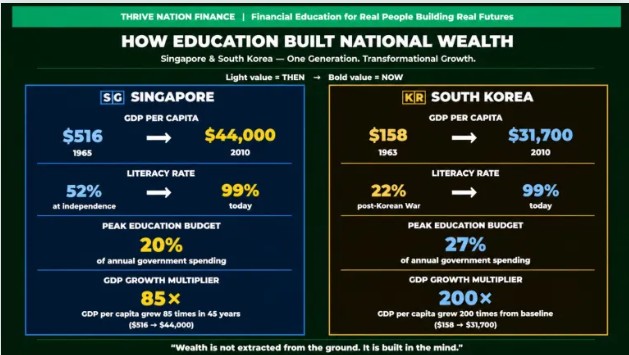
Countries that understood this truth transformed entire nations within a single generation. Singapore had no oil, no farmland, and no natural resources when it gained independence in 1965. Its GDP per capita was just $516. By investing aggressively in human capital and education, it grew that figure by 85 times within 45 years, becoming one of the wealthiest economies on Earth. South Korea followed the same path, rising from 22 percent literacy after the Korean War to becoming a global economic powerhouse, driven almost entirely by its commitment to education and human development.
The same principle applies to every family, every community, and every individual. Wealth is not only extracted from the ground. It is built in the mind and then translated into action, one informed financial decision at a time.
Your Financial Journey Starts Now
Whether you’re a newcomer, a working professional, or someone who was never taught this in school; the best time to start is today.
At Thrive Nation Finance, we help real people build real futures through:
- Practical financial education
- Credit-building guidance
- Savings and investment strategies
- Newcomer support
- Family-focused financial planning
Follow Thrive Nation Finance for honest, accessible, life-changing financial education. Your future self will thank you.